
Choosing the wrong alloy for a precision machined part is the single most common reason a drawing gets reworked after quote. This guide compares brass, copper and aluminium on machinability, strength, corrosion resistance and cost so a design engineer can pick the right material the first time.
Every recommendation below is drawn from published alloy data and shop-floor experience, not from a single supplier’s preference. Where a number is quoted, its source is named.
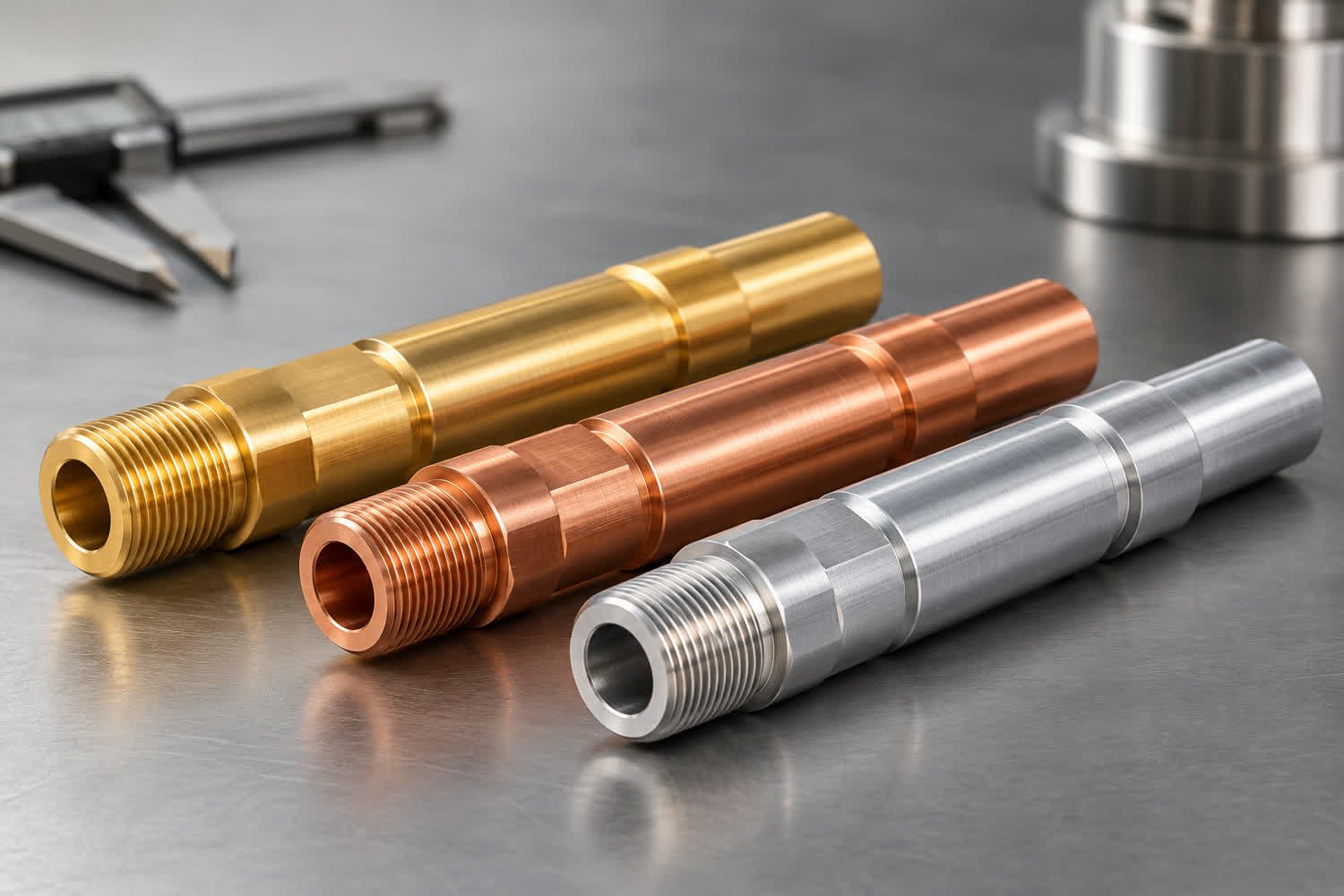
Quick answer: for most precision turned parts that need threads, sealing faces or electrical contact, free-cutting brass C36000 is the default. It machines at a CDA rating of 100, holds tolerances down to ±0.02 mm in production, and costs less per finished part than copper or aluminium once cycle time is counted. Choose copper when electrical or thermal conductivity is the governing requirement, and aluminium when weight reduction or anodised finish matters more than wear resistance. All three are viable; the right choice depends on which requirement dominates the drawing.
What does the machinability rating actually measure?
A machinability rating compares an alloy’s relative ease of machining against a reference material. Free-cutting brass C36000 is assigned a rating of 100 on the Copper Development Association (CDA) scale, so every other copper alloy is expressed as a percentage of it. The number is a guide, not a production guarantee: cutting parameters, stock condition, tooling and part geometry all affect the result.
Brass earns its benchmark because 2.5 to 3.0 percent lead sits as discrete particles in the copper-zinc matrix. Those particles break chips and lubricate the cutting edge, which is why C36000 produces short, fragmented chips and runs at 500 to 1,600 surface feet per minute in carbide turning. Copper and aluminium do not chip as cleanly, so their effective cycle times are longer even when the machine is running at the same spindle speed.
Which brass grade should you specify for a turned part?
Ninety percent of machined brass is one of four grades. Specify by UNS number (C36000, C26000, C46400, C69300) rather than the word “brass”, because machinability and corrosion behaviour differ enough that a substitution can ruin a part.
| Grade (UNS) | Composition | CDA machinability | Best for |
|---|---|---|---|
| C36000 (free-cutting) | 60 Cu / 35.5 Zn / 3 Pb | 100 (benchmark) | Screw-machine parts, fittings, valve stems, gears, connectors |
| C26000 (cartridge) | 70 Cu / 30 Zn | ~30 | Deep-drawn and cold-formed parts, terminals, radiator cores |
| C46400 (naval) | 60 Cu / 0.75 Sn / bal Zn | ~30 | Marine hardware, seawater-exposed fittings, propeller shafts |
| C69300 (lead-free silicon) | Cu / Zn + Si / Bi | ~85 | Potable-water and food-contact parts, RoHS-restricted markets |
| C38500 (architectural) | 57 Cu / 40 Zn / 3 Pb | ~90 | Extrusions, architectural hardware, forgings |
Default to C36000 unless a requirement pushes you off it. A part that is purely machined, with no forming step, no marine exposure and no lead restriction, should almost always be C36000: it is the lowest-cost answer per finished part because the cycle time is shortest. Move to C26000 only when the drawing needs deep drawing or cold forming, to C46400 for seawater service, and to C69300 (ECO BRASS) for potable water or RoHS-restricted electronics, where C36000’s lead content fails the 0.25 percent weighted-average limit on wetted surfaces under the US Safe Drinking Water Act.
When should you choose copper instead of brass?
Choose copper when electrical or thermal conductivity is the governing requirement. Pure copper (C11000, electrolytic tough pitch) conducts electricity and heat better than any brass alloy, which is why it is specified for electrical terminals, bus bars, heat sinks and heat-exchanger tubes. The trade-off is machinability: copper rates roughly 20 percent on the CDA scale, so a copper part takes about five times longer to machine than the same geometry in C36000 brass.
Copper also work-hardens during cutting, which means tooling wears faster and surface finish degrades unless feeds and speeds are reduced. For a part where conductivity matters but some machinability is still needed, tellurium copper (C14500) or phosphorus-deoxidised copper (C12200) offer a compromise at around 85 to 90 percent machinability with conductivity still close to pure copper.
When does aluminium make more sense than brass or copper?
Aluminium makes sense when weight reduction, anodised finish or cost of raw material dominates the decision. Aluminium weighs roughly one-third of brass (2.8 g per cubic centimetre versus 8.4), so for a part where every gram counts, aluminium is the obvious choice. Free-machining aluminium grades such as 2011 (AISI 2011) and 6061 machine well, at 70 to 90 percent of the C36000 benchmark, and anodising gives a hard, wear-resistant surface that brass cannot match.
The catch is strength and wear resistance. Aluminium is softer than brass, so threads strip more easily and sliding surfaces wear faster. For a precision turned part with fine threads, a sealing face or a bearing surface, aluminium is usually the wrong choice unless the application is specifically weight-critical. Aluminium also cannot be plated with the same finishes as brass, so if the drawing calls for nickel or chrome plating, brass or copper is the better base.
How do brass, copper and aluminium compare on cost per finished part?
Raw material price alone is misleading. Brass C36000 rod costs roughly 1.5 to 2 times aluminium A2011 per kilogram, but because brass machines five times faster with less tool wear, the finished-part cost often favours brass for complex turned geometries. Copper is the most expensive of the three on both material and machining cost.
A fair comparison uses cost per finished part, not cost per kilogram. For a simple pin or bushing with no threads, aluminium may win on material cost. For a threaded fitting, valve stem or connector with multiple operations, brass almost always wins because the cycle-time saving outweighs the higher bar price. Ask the supplier for a cycle-time estimate on your actual drawing rather than comparing bar prices.
Key takeaways
- Default to C36000 free-cutting brass for precision turned parts unless the drawing demands forming, marine service, potable water or RoHS compliance.
- Choose copper for electrical and thermal conductivity, accepting five times the machining time of brass.
- Choose aluminium for weight reduction and anodised finish, not for threads, sealing faces or wear surfaces.
- Compare suppliers on cost per finished part, including cycle time and tooling, never on raw material price alone.
Frequently asked questions
Is C36000 brass RoHS compliant?
Yes, but only through Annex III exemption 6(c) of Directive 2011/65/EU. Its lead content of 2.5 to 3.7 percent disqualifies it from wetted potable-water surfaces under US and EU drinking-water rules, so faucets, meter bodies and potable-water fittings must use lead-free grades such as C69300.
Can brass be anodised like aluminium?
No. Brass cannot be anodised. A drawing that calls for an anodised brass part requires an alloy or finish change, typically to aluminium with an appropriate anodising specification, or to brass with a plated finish instead.
What tolerance can a CNC turned brass part hold in production?
Turning delivers the most predictable control of diameter, roundness, bore size and concentricity. In production, ±0.02 mm is a typical tolerance on turned brass features, with tighter values achievable on qualifying features under controlled conditions. The tolerance depends on feature type, not on a single blanket capability number.
Should I specify brass by UNS number or by common name?
Always by UNS number. The word “brass” on a drawing is not specific enough: machinability and corrosion behaviour differ so widely between grades that a substitution can wreck a part. Write C36000, C26000, C46400 or C69300, and quote the governing standard (ASTM B16 for C36000 rod and bar, for example).
Company facts: Premi Brasscom International, precision-turned metal components manufacturer since 1984, ISO 9001:2015 and IATF 16949 certified, 550+ standard products and 300+ custom components, Plot No. 3056, G.I.D.C. Phase III, Dared, Jamnagar 361 004, Gujarat, India. Internal links: LPG parts, pneumatic parts, sanitary parts, electrical parts, automotive brass components, quality, enquiry. Sources: Copper Development Association alloy data; IsoCNC Engineering Team, “Machining Brass: Grades, Speeds, and Shop Tactics”, August 2026; Precision Advanced Manufacturing, “Precision CNC Machining Brass: Alloys, Tolerances & Finishes”, June 2026; E&H Precision, “Is Brass Machining Really Cost-Effective?”, August 2026; Copper Products B2B, “Brass Alloy Selection Checklist for Industrial Projects”, October 2026.