
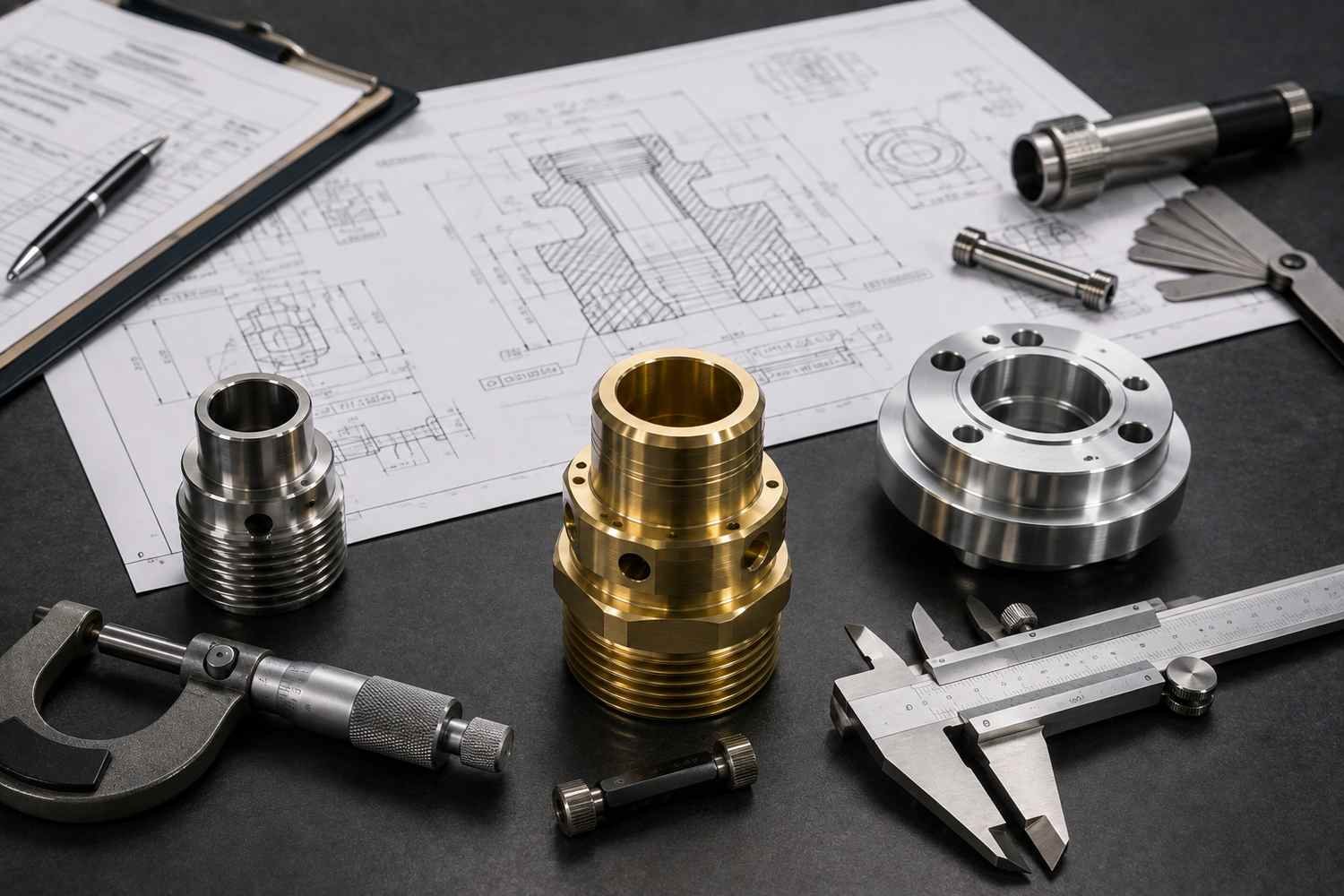
Why Global OEMs Are Looking to India for Auto Components in 2026
Key takeaway: India already exports billions of dollars of automotive components, but its share of the world’s largest auto-component import markets remains relatively small. That creates an opportunity for global OEMs and Tier-1 suppliers to develop additional Indian sources for precision components. The critical requirement is not simply lower cost—it is consistent quality, precision manufacturing, testing, tooling, capacity and supplier reliability.
Global automotive sourcing is changing.
OEMs and Tier-1 suppliers are increasingly looking beyond traditional sourcing locations to build more resilient and competitive supply chains.
India is already part of that global automotive supply chain.
But there is an important distinction:
India is a significant auto-component exporter, yet there is still substantial room for Indian suppliers to increase their share of global OEM sourcing.
That creates an opportunity for both sides.
For global buyers, India can provide another potential manufacturing and sourcing base.
For Indian component manufacturers, the opportunity is to move from cost-focused supply toward higher-value, qualification-driven global sourcing.
How Large Is India’s Auto-Component Export Opportunity?
India’s auto-component exports reached approximately $22.9 billion in FY2025, according to ACMA, representing 8% growth over the previous year.
North America recorded an 8.4% increase in India’s component exports, while Asia grew 15.1%. Major export categories included drive transmission and steering systems, engine components, suspension and braking systems, and body and chassis products.
The broader opportunity is even larger.
NITI Aayog’s latest Trade Watch identifies the global market for parts and accessories covered under HS 8708 at approximately $451.2 billion in 2024. India’s leading destinations included the United States, Türkiye and Mexico.
This creates a straightforward conclusion:
India already has an established export position, but its potential global market share is far from exhausted.
Why Are Global OEMs Considering India?
Global OEMs are considering India because the country combines an established automotive manufacturing ecosystem with a growing export base and a large supplier network.
A global procurement team evaluating India may be looking for:
- Additional sourcing capacity
- Cost competitiveness
- Supplier diversification
- Engineering capability
- Precision manufacturing
- Export experience
- Alternative supply locations
- Access to Indian automotive production
- Potential Tier-1 supplier development
India is therefore not an untested manufacturing destination.
The challenge is identifying suppliers that meet the buyer’s specific technical and quality requirements.
Is India Already a Major Auto-Component Exporter?
Yes, but India’s global market penetration remains much smaller than the size of the global opportunity.
NITI Aayog’s analysis shows that the United States, Germany and Mexico are among the world’s largest importers of vehicle parts and accessories.
Yet India has significant room to increase its share in these markets.
For HS 8708 parts and accessories, NITI reports that India’s export basket is anchored by the USA, Türkiye and Mexico.
This is commercially important.
It means Indian suppliers are already selling into markets where major automotive manufacturing and assembly ecosystems operate.
The next challenge is moving further into higher-value and OEM-oriented supply chains.
What Is Preventing India From Capturing More Global Auto-Component Demand?
The main challenge is not simply manufacturing cost. Higher-value global supply requires precision, testing, tooling, quality consistency and close alignment with OEM and Tier-1 requirements.
NITI Aayog specifically identifies the need for:
- Scaling precision manufacturing
- Investment in tooling
- Electronic components
- Alignment with global Tier-1 suppliers
to help India move into higher-value automotive segments.
This is an important point for suppliers.
Being able to manufacture a component is only the first step.
A global OEM may also need evidence that the supplier can repeatedly manufacture the same component to the required specification.
What Does a Global OEM Look for in an Indian Component Supplier?
A global OEM or Tier-1 supplier typically needs evidence of technical capability, quality control, capacity, traceability and commercial reliability before approving a new source.
A practical evaluation can include:
| Evaluation area | What the buyer wants to know |
|---|---|
| Drawing capability | Can the supplier manufacture the latest drawing revision? |
| Material | Can the required grade be consistently sourced? |
| Tolerance | Can critical dimensions be maintained? |
| Process | Is the process stable for repeat production? |
| Inspection | Can critical characteristics be measured? |
| Quality | Is an appropriate quality system in place? |
| Capacity | Can programme volumes be supported? |
| Tooling | Can required tooling be developed and maintained? |
| Traceability | Can batches and production records be traced? |
| Development | Can samples be developed and qualified? |
| Delivery | Can production schedules be maintained? |
| Export | Can international logistics and documentation be handled? |
| Cost | Is total landed cost competitive? |
This is why supplier qualification is more important than simply finding the cheapest quotation.
Why Is Precision Manufacturing Becoming More Important?
As Indian suppliers target higher-value automotive exports, precision and repeatability become increasingly important.
A component may appear simple.
But the actual production requirement can include:
- Tight dimensional tolerances
- Controlled threads
- Consistent surface finish
- Material-grade requirements
- Critical diameters
- Concentricity
- Repeatable batch production
- Inspection records
- Traceability
- Customer-specific quality requirements
A supplier that produces a component correctly once is not necessarily capable of producing it consistently thousands of times.
That difference is critical for OEM sourcing.
Why Does Tooling Matter?
Tooling determines whether a component can be produced consistently, economically and at the required production volume.
Depending on the component, tooling can influence:
- Cycle time
- Dimensional consistency
- Production efficiency
- Tool life
- Surface finish
- Repeatability
- Overall component cost
For a global OEM, tooling capability can therefore become part of supplier qualification.
A supplier-development programme may involve:
Drawing review → tooling development → sample → inspection → approval → production
The exact process depends on the component and customer.
Why Is Testing Important for Higher-Value Automotive Components?
Testing and inspection provide evidence that the manufactured component meets the specified requirements.
For precision components, inspection can involve characteristics such as:
- Outside diameter
- Inside diameter
- Length
- Thread dimensions
- Bore dimensions
- Surface roughness
- Profile
- Critical geometric features
For automotive programmes, the required inspection and validation process depends on the customer’s quality requirements.
This is why global buyers increasingly evaluate not only the machine shop, but also the supplier’s measurement and quality infrastructure.
What Is the Difference Between Tier-1 and Tier-2 Automotive Suppliers?
A Tier-1 supplier generally supplies directly to an OEM, while Tier-2 suppliers commonly supply components or subassemblies to Tier-1 suppliers.
The automotive supply chain can be simplified as:
OEM
↓
Tier-1 system supplier
↓
Tier-2 component supplier
↓
Tier-3 / material / process supplier
NITI Aayog describes this layered automotive supply structure and notes that Tier-1 suppliers directly interface with OEMs, while Tier-2 and lower-tier suppliers provide components, subassemblies or materials into the chain.
For a precision component manufacturer, becoming a reliable Tier-2 supplier can therefore be an important route into global OEM programmes.
Why Can Tier-2 Suppliers Be Important to OEM Localisation?
OEMs and Tier-1 suppliers cannot build complex automotive products without a deeper supplier network.
A Tier-1 supplier may require hundreds of individual components.
Those components can include:
- Precision turned parts
- Fasteners
- Shafts
- Bushings
- Inserts
- Terminals
- Connectors
- Aluminium components
- Brass components
- Copper components
- Steel components
- Stainless-steel components
The Tier-1 supplier may not manufacture every individual component internally.
That creates opportunities for qualified Tier-2 manufacturers.
Which Metal Components Can Be Relevant to Automotive Sourcing?
Brass, copper, aluminium, steel and stainless steel can all be relevant to automotive applications, depending on the engineering specification.
Brass
Potential applications include:
- Terminals
- Connectors
- Inserts
- Electrical fittings
- Precision-machined components
Copper
Potential applications include:
- Conductive components
- Electrical connections
- Terminals
- Selected power-related components
Aluminium
Potential applications include:
- Housings
- Mounting components
- Structural parts
- Thermal-management components
- Precision-machined components
Steel
Potential applications include:
- Shafts
- Fasteners
- Mechanical interfaces
- Mounting components
Stainless Steel
Potential applications include:
- Corrosion-sensitive components
- Mechanical interfaces
- Fasteners
- Precision components
The material and application must always be confirmed against the customer’s drawing and specification.
What Automotive Components Are Attractive for Indian Export Suppliers?
Components with clearly defined specifications, repeatable manufacturing processes and established global demand can be good candidates for supplier development.
NITI Aayog identifies HS 8708 parts and accessories as a major global market and specifically points to precision manufacturing, tooling and Tier-1 alignment as areas that can help India move into higher-value segments.
Potential categories for evaluation can include:
- Precision turned components
- Drive-related components
- Engine-related components
- Suspension components
- Braking-related components
- Body and chassis components
- Electrical connectors
- Terminals
- Inserts
- Fasteners
- Bushings
- Shafts
The actual suitability depends on the component design and supplier capability.
Is India Competing Only on Cost?
No. Cost remains important, but global automotive sourcing increasingly depends on a combination of cost, quality, engineering capability and supply reliability.
A procurement team may compare:
Piece price
but the more useful comparison is:
Total landed cost + quality risk + delivery risk + development cost + supplier capability
For example, a supplier with a lower quoted price may become more expensive if it creates:
- Higher rejection rates
- Additional inspection
- Delivery delays
- Rework
- Production interruptions
- Requalification costs
This is why serious OEM sourcing should evaluate the complete supplier proposition.
What Should a Global Buyer Include in an RFQ?
The more complete the RFQ, the more accurately an Indian supplier can evaluate feasibility and provide a quotation.
A strong RFQ should ideally include:
- Engineering drawing
- Drawing revision
- Material specification
- Annual volume
- Monthly volume
- Surface-finish requirement
- Critical tolerances
- Inspection requirements
- Packaging requirements
- Delivery location
- Development timeline
- Applicable customer standards
The supplier can then assess:
Manufacturability → Process → Tooling → Inspection → Capacity → Cost → Delivery
What Should an Indian Supplier Include in an OEM RFQ Response?
A serious supplier response should demonstrate manufacturing feasibility rather than simply provide a unit price.
A useful response can include:
- Drawing review
- Material confirmation
- Process feasibility
- Tooling requirement
- Sample-development timeline
- Inspection approach
- Production capacity
- Lead time
- Packaging
- Commercial quotation
- Relevant quality documentation
This gives the procurement team evidence to evaluate the supplier.
What Does the Current Indian Export Data Tell Global Buyers?
The data suggests that India is already integrated into international automotive trade, but there remains substantial room for deeper penetration into global OEM supply chains.
ACMA reports India’s auto-component exports at $22.9 billion in FY2025, while NITI Aayog’s analysis identifies a $451.2 billion global market for HS 8708 parts and accessories.
These numbers should not be interpreted as saying India can immediately capture the entire gap.
They show something more useful:
There is a large global market, and India already has an established export position within it.
The opportunity is to move further into higher-value, technically demanding supply chains.
What Does This Mean for EV and Next-Generation Vehicles?
The shift toward EVs changes the component mix, but it does not eliminate the need for precision metal manufacturing.
Electric vehicles still require:
- Mechanical interfaces
- Housings
- Shafts
- Fasteners
- Connectors
- Terminals
- Mounting components
- Thermal-management components
- Precision-machined parts
The exact requirements change as vehicle architecture changes.
Therefore, precision manufacturers should not think only in terms of traditional ICE components.
The broader opportunity is:
Precision manufacturing for evolving vehicle platforms.
What Is the Opportunity for Premi Brasscom International?
Premi Brasscom International operates in precision metal components across brass, copper, aluminium, steel and stainless steel, with applications including automotive, electrical, electronic and industrial requirements.
The current direction of India’s automotive supply chain is therefore commercially relevant.
But the positioning should remain precise.
Premi should not claim:
“We supply global OEMs.”
unless a specific OEM relationship can be publicly substantiated.
A stronger positioning is:
“We manufacture precision metal components against customer drawings and specifications for automotive, electrical, electronic and industrial applications.”
The sourcing process is:
Drawing / Sample
↓
Manufacturing Feasibility
↓
Sample Development
↓
Inspection / Qualification
↓
Production
↓
Repeat Supply
This is the type of supplier-development pathway a global procurement team can evaluate.
What Should Global OEMs Do Before Choosing an Indian Supplier?
Global buyers should qualify Indian suppliers against the same technical and commercial standards they would apply to suppliers in any other manufacturing country.
A practical process is:
Step 1 — Identify the component
Define the drawing, material and annual requirement.
Step 2 — Identify suitable suppliers
Shortlist manufacturers with relevant process and material capabilities.
Step 3 — Review manufacturing feasibility
Ask whether the supplier can actually produce the component consistently.
Step 4 — Develop samples
Validate dimensions, materials and other required characteristics.
Step 5 — Complete qualification
Apply the customer’s quality and approval requirements.
Step 6 — Compare total landed cost
Include freight, duties, packaging and other applicable costs.
Step 7 — Start controlled production
Begin with approved quantities and monitor supplier performance.
Step 8 — Develop the relationship
Move toward repeat production and additional components where performance is proven.
Frequently Asked Questions
Is India a good source for automotive components?
Yes. India already has a substantial automotive-component manufacturing and export ecosystem. ACMA reports $22.9 billion of auto-component exports in FY2025.
How large is the global auto-component market?
NITI Aayog’s Trade Watch identifies approximately $451.2 billion of global imports for HS 8708 parts and accessories in 2024.
Which countries are major markets for Indian auto components?
The United States, Türkiye and Mexico are among India’s leading export destinations for HS 8708 parts and accessories.
Can US OEMs source auto components from India?
Yes. Indian suppliers already export automotive components to the US market, and the US is a major destination for India’s auto-component exports.
What is a Tier-2 automotive supplier?
A Tier-2 supplier typically supplies components or subassemblies to a Tier-1 supplier rather than directly to the vehicle OEM.
Why is precision manufacturing important for automotive suppliers?
Precision manufacturing enables suppliers to consistently meet dimensional, material and functional requirements across production batches.
What metals can Indian precision component manufacturers supply?
Depending on their manufacturing capabilities, suppliers can work with materials such as brass, copper, aluminium, steel and stainless steel.
What should an OEM check before sourcing from India?
The OEM should evaluate manufacturing capability, material capability, tolerances, inspection, quality systems, tooling, capacity, traceability, delivery and total landed cost.
Is India competing with China only on price?
No. Indian suppliers increasingly need to compete on quality, engineering capability, precision, reliability and delivery as well as cost.
Can a Tier-2 supplier become part of a global OEM supply chain?
Yes. Tier-2 suppliers can supply components to Tier-1 companies whose assemblies ultimately enter OEM production programmes.
How can an international buyer start sourcing a precision component from India?
The best starting point is to provide the supplier with the drawing or sample, material specification, annual volume and quality requirements for a manufacturing-feasibility review.
Conclusion
India is already an important automotive-component exporter.
But the bigger story is the gap between India’s existing export position and the much larger global market available to qualified suppliers.
ACMA reports approximately $22.9 billion in Indian auto-component exports in FY2025, while NITI Aayog identifies a global HS 8708 market of approximately $451.2 billion.
NITI’s recommendation is particularly relevant for precision manufacturers: India needs to scale precision manufacturing, tooling, electronic components and alignment with global Tier-1 suppliers to move into higher-value segments.
For global OEMs and Tier-1 suppliers, that means India deserves to be evaluated as more than a low-cost sourcing destination.
The real question is:
Which Indian suppliers can meet the required engineering, quality, capacity and delivery standards consistently?
For Indian manufacturers, that is the opportunity.
Not simply to manufacture more components.
But to become a more qualified part of the global automotive supply chain.
Premi Brasscom International manufactures precision metal components in brass, copper, aluminium, steel and stainless steel for automotive, electrical, electronic and industrial applications.
International buyers can share a component drawing, sample, material specification or sourcing requirement for manufacturing-feasibility evaluation.
Use these as your authoritative evidence base:
- NITI Aayog — Trade Watch: April–June 2026 — strongest source for the $451.2B HS 8708 market, India’s destination mix and the precision-manufacturing/Tier-1 opportunity.
- ACMA — Indian Auto Component Industry — $22.9B FY25 exports and category/export-market data.
- NITI Aayog — Global Champions in Automotive Industry in India — useful for explaining OEM/Tier-1/Tier-2 structure.
- Department of Commerce — Trade Intelligence & Analytics — government engineering-trade data.
- Department of Commerce — TRADESTAT — government monthly commodity/country trade data.
Is India a good source for automotive components?
- How large is the global auto-component market?
- Which countries are major markets for Indian auto components?
- Can US OEMs source auto components from India?
- What is a Tier-2 automotive supplier?
- Why is precision manufacturing important?
- What metals can Indian precision manufacturers supply?
- What should an OEM check before sourcing from India?
- Is India competing with China only on price?
- Can a Tier-2 supplier become part of a global OEM supply chain?
- How can an international buyer start sourcing a precision component from India?