
India’s automotive component industry is entering another important phase of growth.
The Indian auto component industry recorded a turnover of approximately ₹7.6 lakh crore (US$85.9 billion) in FY2025–26, registering 12.7% year-on-year growth, according to industry data reported by the Automotive Component Manufacturers Association of India (ACMA).
For OEMs, Tier-1 suppliers and procurement teams, this growth creates an important question:
As automotive production increases, how will manufacturers secure reliable suppliers for the thousands of precision components required across modern vehicles?
This is where precision metal component manufacturing becomes increasingly important.
India’s Auto Component Industry Is Expanding
India’s automotive component sector has benefited from strong domestic demand, higher vehicle production, continued investment in manufacturing capacity and technology, and growing exports.
The industry’s FY2025–26 turnover reached approximately ₹7.6 lakh crore, demonstrating the increasing scale of India’s automotive manufacturing ecosystem.
Government initiatives are also supporting domestic manufacturing.
Under the Production Linked Incentive scheme for automobiles and auto components, cumulative investment had reached ₹44,326 crore by March 2026, with incremental sales of ₹52,414 crore and 67,820 jobs generated.
The direction is clear:
India is becoming an increasingly important manufacturing and sourcing base for automotive components.
But higher production volumes also create higher expectations from suppliers.
Why Precision Metal Components Matter in Automotive Manufacturing
Modern vehicles depend on thousands of individual components.
Not every component is large or visible.
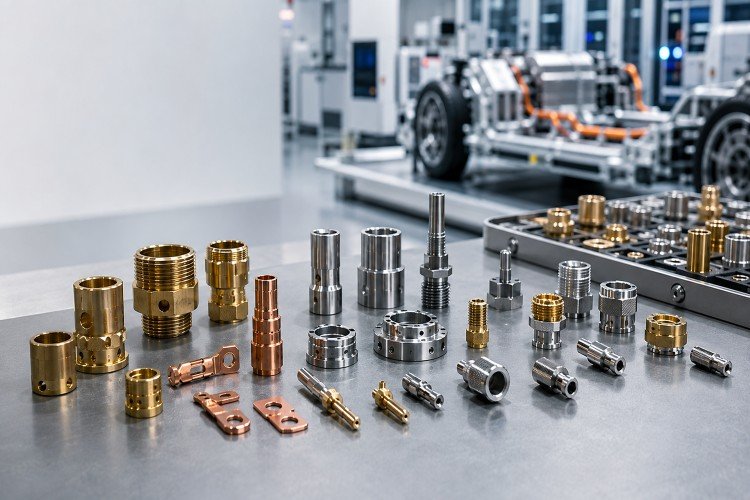
Many are relatively small precision-engineered parts that perform critical functions inside larger assemblies.
Examples include:
- Precision turned components
- Brass automotive components
- Copper electrical components
- Aluminium machined components
- Bushes
- Pins
- Inserts
- Terminals
- Connectors
- Threaded components
- Fasteners
- Custom machined parts
- Sheet-metal components
The challenge for manufacturers is not simply producing these components.
The challenge is producing them consistently, repeatedly and according to the customer’s drawing and specification.
For an automotive procurement team, a component that meets the specification once is not enough.
The supplier needs to demonstrate production consistency.
The Shift From Low-Cost Sourcing to Reliable Sourcing
Price will always matter in automotive procurement.
But price alone does not determine the real cost of a component.
A supplier offering a lower unit price may become more expensive if the buyer experiences:
- Dimensional variation
- Rejected batches
- Delayed deliveries
- Inconsistent material
- Poor surface finish
- Threading problems
- Packaging issues
- Unstable production quality
- Difficult communication
- Inadequate documentation
For this reason, automotive buyers increasingly need to evaluate suppliers based on the complete manufacturing capability behind the quoted price.
A reliable supplier should be able to support:
Material → Machining → Inspection → Consistency → Documentation → Delivery
That complete chain is what ultimately determines supply reliability.
Why Brass, Copper and Aluminium Are Important
Different automotive and electrical applications require different material characteristics.
Brass Components
Brass offers a combination of machinability, corrosion resistance and electrical conductivity.
This makes brass useful for various automotive, electrical, electronic, pneumatic and industrial applications.
Precision brass components can include threaded parts, inserts, terminals, connectors, bushes and custom turned components.
Copper Components
Copper is particularly important where electrical conductivity is a major requirement.
Copper components are therefore widely relevant to electrical and electronic assemblies and the growing electrification ecosystem.
Aluminium Components
Aluminium provides a useful combination of low density, machinability and strength-to-weight advantages.
As manufacturers continue looking for opportunities to reduce weight, aluminium components can become increasingly relevant in suitable applications.
The correct material, however, should always be selected according to the customer’s engineering requirements rather than simply choosing the lightest or cheapest option.
EV Growth Is Changing the Component Supply Chain
The automotive industry is also moving toward greater electrification.
Recent developments in India’s auto-component sector show suppliers expanding their capabilities to serve EV-related applications.
This transition is important for precision metal manufacturers because electric vehicles increase the importance of electrical and electronic systems.
The opportunity is not limited to batteries.
The broader ecosystem includes:
- Electrical connectors
- Terminals
- Conductive components
- Precision inserts
- Fasteners
- Charging-system components
- Motor-related components
- Electronic assemblies
- Custom machined metal parts
As automotive systems become more electronically integrated, the importance of reliable suppliers for small precision components can increase as well.
What Should Automotive Buyers Look for in a Precision Component Supplier?
Choosing a precision component supplier should involve more than comparing quotations.
Here are five areas procurement and engineering teams should evaluate.
1. Material Capability
Can the supplier manufacture the required component in the specified material?
A supplier capable of working with multiple metals can provide greater flexibility across different applications.
2. Manufacturing Capability
The supplier should have suitable machining and production processes for the component’s diameter, geometry, tolerance and production volume.
3. Quality Control
Production quality should be supported by appropriate inspection and process controls.
Dimensional inspection, thread inspection, surface-finish checks and other application-specific inspections can be critical depending on the component.
4. Production Consistency
A supplier should demonstrate that the same component can be produced repeatedly according to specification.
This becomes particularly important when production moves from prototype or sample quantities to larger volumes.
5. Delivery Reliability
A technically capable supplier still creates problems if production cannot be delivered according to schedule.
Procurement teams should therefore evaluate capacity, production planning, communication and delivery performance together with price and quality.
Where Premi Brasscom International Fits
Premi Brasscom International has been manufacturing and exporting metal components since 1984.
The company’s product range includes precision components manufactured from:
- Brass
- Copper
- Aluminium
- Stainless steel
- Mild steel
Its catalogue includes automotive components, electrical components, electronic components, fasteners, pneumatic parts, sanitary components, LPG-related components, transformer parts and other custom metal components.
For customers requiring components according to drawings, specifications or application requirements, the ability to manufacture across multiple materials and component categories can simplify supplier sourcing.
The company also holds IATF 16949:2016 and ISO 9001:2015 certifications, supporting its positioning within quality-conscious manufacturing and automotive supply chains.
What This Means for Automotive Procurement Teams
India’s automotive component industry is growing rapidly.
At the same time, vehicle architectures are becoming more complex, electrification is increasing and manufacturers are looking for stronger domestic and global supply chains.
For procurement teams, this creates an opportunity to reassess their precision component supply base.
Instead of asking only:
“Who can give us the lowest price?”
the more important question is:
“Who can consistently manufacture the required component to specification, at the required volume, with dependable quality and delivery?”
That distinction becomes increasingly important as production volumes increase.
Conclusion
India’s automotive component industry is becoming a larger and more strategically important part of the global manufacturing ecosystem.
The growth of domestic vehicle production, exports, electrification and manufacturing investment is creating opportunities throughout the supply chain.
Precision metal components may be small, but their role in automotive, electrical and electronic assemblies can be critical.
For OEMs, Tier-1 suppliers and industrial buyers looking for precision brass, copper, aluminium, stainless-steel or mild-steel components, selecting the right manufacturing partner can make a significant difference to quality, supply continuity and production efficiency.
Looking for a precision metal component manufacturer for your automotive, electrical or industrial application?
Contact Premi Brasscom International with your drawing, sample or component requirement to discuss your manufacturing needs.