
India Rare Earth Magnet Manufacturing 2026: What It Means for EV Supply Chains
Key takeaway: India is moving from policy planning toward competitive bidding for domestic rare-earth permanent magnet manufacturing. The government’s ₹7,280-crore scheme targets 6,000 metric tonnes per annum (MTPA) of integrated sintered NdFeB magnet capacity, while official estimates put India’s 2030 REPM demand at 8,220 MTPA, including 3,250 MTPA from electric vehicles. For automotive procurement teams, the development matters because rare-earth magnets are a critical input for several high-performance motor applications and because India is trying to build a more complete domestic EV supply chain.
India’s automotive localisation story is entering a more technically important phase.
The discussion is no longer limited to vehicle assembly, batteries or conventional automotive components.
India is now trying to strengthen domestic production of a critical material used in high-performance motors and other advanced technologies: sintered neodymium-iron-boron, or NdFeB, rare-earth permanent magnets.
The development has moved beyond a government announcement.
In March 2026, the Ministry of Heavy Industries issued a global tender for integrated sintered NdFeB rare-earth permanent magnet manufacturing facilities with a combined capacity of 6,000 MTPA. The scheme carries a financial outlay of ₹7,280 crore, including capital subsidy and sales-linked incentives.
The bidding process subsequently received multiple extensions, with the final bid deadline moved to August 12, 2026 and technical bids scheduled to open on August 13. Recent reporting says the scheme attracted 20 bids, indicating substantial industry interest.
For automotive companies, the bigger question is:
Why do rare-earth magnets matter to India’s EV supply chain?
What are rare-earth permanent magnets?
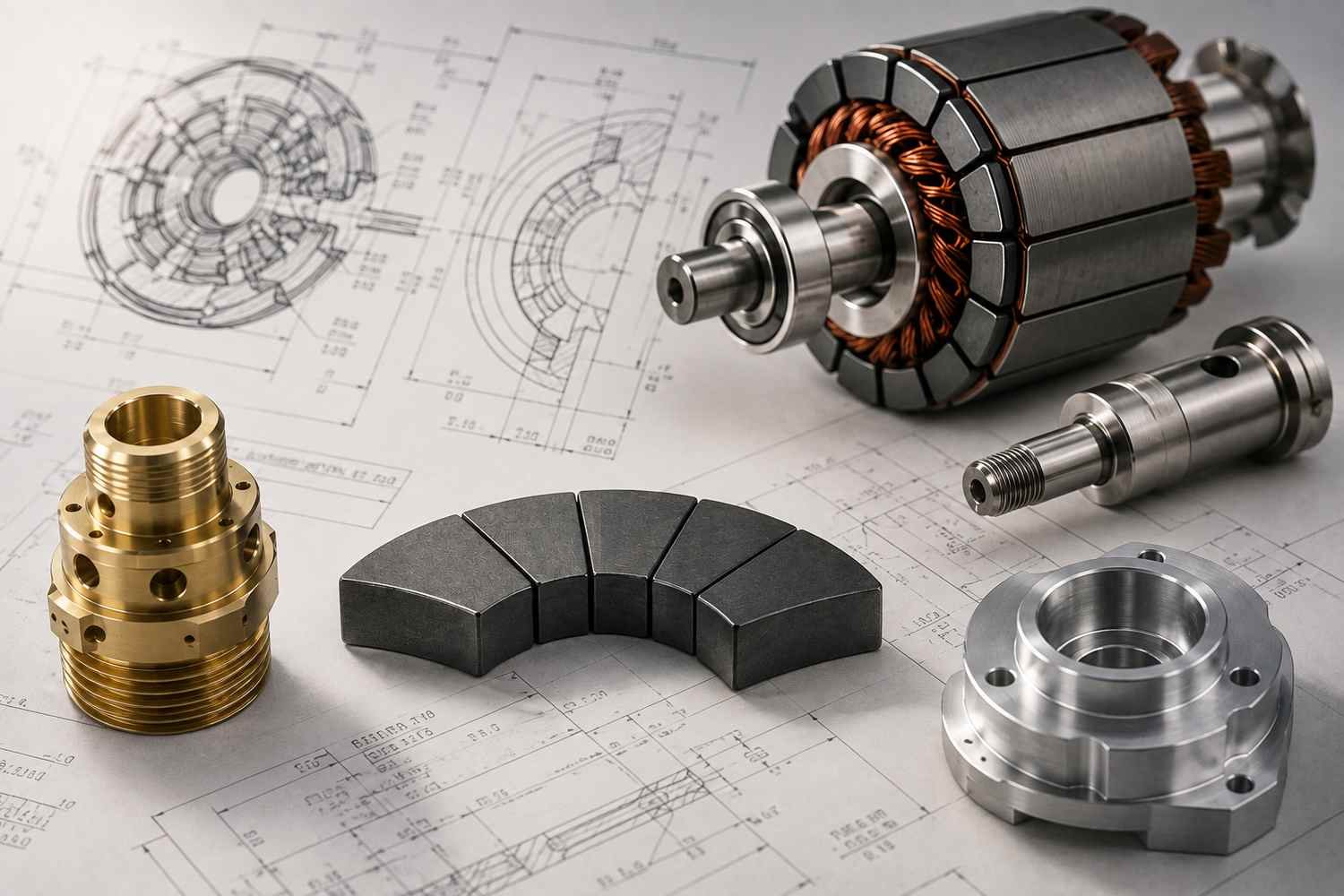
Rare-earth permanent magnets are high-performance magnets that use rare-earth elements to achieve very high magnetic strength and energy density.
Sintered NdFeB magnets are particularly important because they provide strong magnetic performance in relatively compact forms.
The Ministry of Heavy Industries identifies rare-earth permanent magnets as important inputs for:
- Electric vehicles
- Wind turbines
- Electronics
- Aerospace
- Defence
- Industrial motors
For automotive applications, their importance is closely connected to electric motors.
A motor converts electrical energy into mechanical motion. Permanent magnets can provide the magnetic field required for high-performance motor designs, allowing manufacturers to achieve high power and torque density.
That makes magnet availability relevant to the wider EV manufacturing ecosystem.
Why is India investing ₹7,280 crore in rare-earth magnet manufacturing?
India is investing in domestic rare-earth magnet manufacturing because it currently lacks sufficient industrial-scale midstream capacity to convert rare-earth oxides into metals, alloys and finished sintered magnets.
A July 2026 Ministry of Heavy Industries assessment states that India currently imports all of its sintered NdFeB REPM demand for downstream applications. The government says the country has upstream capabilities in mining, separation and oxide refining, but has a notable gap in the industrial-scale midstream stages from oxide to metal, metal to alloy and alloy to magnet.
This is a classic supply-chain problem.
Having mineral resources is not the same as having the ability to manufacture the finished advanced material.
The value chain can be simplified as:
Rare-earth resources
↓
Mining
↓
Separation
↓
Oxide
↓
Metal
↓
Alloy
↓
Magnet powder
↓
Sintered NdFeB magnet
↓
Motor / industrial application
India’s new policy is aimed at strengthening the downstream portion of that chain.
How much rare-earth magnet capacity is India planning to build?
The government is targeting up to 6,000 MTPA of integrated sintered NdFeB rare-earth permanent magnet manufacturing capacity.
The scheme was approved with a financial outlay of ₹7,280 crore. The March 2026 RFP allowed manufacturers to establish integrated facilities and provided for capital subsidy and sales-linked incentives.
The scheme envisages multiple beneficiaries rather than a single manufacturer.
The government notification specifies allocated capacities ranging from 600 MTPA to 1,200 MTPA, in increments of 100 MTPA.
That structure is significant because it is designed to create an ecosystem rather than simply fund one demonstration plant.
How large could India’s rare-earth magnet demand become by 2030?
The government estimates India’s consolidated REPM demand could reach 8,220 MTPA by 2030.
The July 2026 assessment breaks projected demand across several sectors:
| Application | Estimated 2030 REPM demand |
|---|---|
| Electric vehicles | 3,250 MTPA |
| Wind turbines | 1,800 MTPA |
| BLDC fans | 980 MTPA |
| Other applications | 820 MTPA |
| Smartphones & computers | 600 MTPA |
| Industrial motors | 500 MTPA |
| Solar-powered pumps | 170 MTPA |
| Elevators & escalators | 100 MTPA |
| Total | 8,220 MTPA |
The automotive number stands out.
At 3,250 MTPA, electric vehicles represent the largest individual demand category identified in the government’s assessment.
This is why rare-earth magnet manufacturing should not be viewed only as a mining or materials story.
It is an automotive supply-chain story.
What does rare-earth magnet manufacturing mean for India’s EV industry?
Domestic rare-earth magnet production could strengthen an important part of India’s EV manufacturing chain by reducing dependence on imported NdFeB magnets.
The government explicitly connects the REPM scheme with electric mobility and other strategic industries.
But there is an important distinction.
Domestic magnet manufacturing does not automatically create a fully localised EV.
An EV contains a complex combination of:
- Battery cells and materials
- Power electronics
- Motor systems
- Controllers
- Sensors
- Charging equipment
- Thermal-management systems
- Structural components
- Precision mechanical components
- Electrical connectors
- Fasteners
- Housings
- Software and electronics
Therefore:
Magnet localisation is one layer of EV localisation, not the entire EV supply chain.
That distinction is important for procurement teams.
Why is this development important for automotive procurement teams?
The development matters because procurement teams are increasingly being asked to evaluate not only component cost but also supply-chain resilience and localisation.
A component can be inexpensive but strategically risky if it depends on a highly concentrated global supply base.
For OEMs and Tier-1 suppliers, rare-earth magnet localisation could eventually create additional domestic sourcing options for motor-related supply chains.
But procurement teams should avoid assuming that policy announcements immediately create production-ready suppliers.
A new manufacturing facility still needs:
- Technology qualification
- Process validation
- Material consistency
- Quality systems
- Capacity validation
- Reliability testing
- Customer qualification
- Production ramp-up
- Supply-chain integration
So the timeline from government incentive → plant → qualified production → OEM programme can be substantial.
Does India currently have a gap in the rare-earth magnet supply chain?
Yes. The government itself identifies a significant midstream manufacturing gap.
India has rare-earth resources and capabilities in upstream activities, but the Ministry of Heavy Industries says the country lacks sufficient industrial-scale capacity in the conversion stages between oxide and finished magnet.
This creates a strategic distinction:
Resource availability ≠ manufacturing capability.
For advanced manufacturing, the ability to convert raw materials into a controlled, repeatable engineered product is what matters to downstream buyers.
The same principle applies throughout automotive manufacturing.
A country may have aluminium, copper or steel resources, but an OEM still needs suppliers capable of producing a specific component to:
- Defined dimensions
- Defined tolerances
- Defined material grades
- Defined surface requirements
- Defined inspection requirements
- Defined production volumes
The rare-earth magnet programme is therefore another example of India’s broader move toward deeper value-chain capability.
What does the 20-bid response tell us about the market?
The reported 20 bids suggest that industry interest in building domestic rare-earth magnet capacity is substantial.
Recent reporting says the ₹7,280-crore scheme attracted 20 bids, including proposals associated with companies such as Larsen & Toubro, Coal India and ReNew.
This is commercially significant because the government had structured the scheme to attract manufacturers through global competitive bidding.
However, bids are not the same as commissioned production capacity.
That distinction should remain clear.
The next stages include:
Bid evaluation
↓
Selection
↓
Project development
↓
Plant construction / equipment installation
↓
Process qualification
↓
Commercial production
↓
Customer qualification
A procurement team should therefore treat the current development as a strong signal of future supply-chain capacity rather than assuming that 6,000 MTPA is already operating.
How could rare-earth magnet localisation affect automotive suppliers?
The first-order effect is on motor and magnet supply chains, but the wider impact could extend to suppliers supporting EV motor assemblies and related manufacturing systems.
As domestic motor production expands, OEMs and Tier-1 suppliers may need broader local ecosystems around:
- Motor components
- Shafts
- Housings
- Rotors
- Stators
- Bearings
- Fasteners
- Connectors
- Terminals
- Precision-machined components
- Cooling systems
- Sensors
- Electrical interfaces
The exact sourcing opportunity depends on the motor architecture and customer’s design.
This is where precision component manufacturers can become relevant.
However, a supplier should not claim that it is a “rare-earth magnet supplier” merely because it supplies metal components used somewhere in the automotive ecosystem.
The correct positioning is component-specific.
What should OEMs look for when qualifying suppliers in a more localised EV supply chain?
OEMs should evaluate suppliers based on technical capability, process control, quality, traceability, capacity and delivery performance rather than assuming localisation automatically means qualification.
A practical qualification framework is:
| Evaluation area | Buyer question |
|---|---|
| Technical capability | Can the supplier manufacture the required geometry consistently? |
| Material | Can the specified material and grade be controlled? |
| Tolerances | Can critical dimensions be maintained in serial production? |
| Inspection | How are critical characteristics measured? |
| Traceability | Can material and production lots be traced? |
| Capacity | Can the supplier support programme volumes? |
| Process control | Are critical operations controlled and documented? |
| Quality | Is the required quality system in place? |
| Development | Can samples and validation parts be supplied on schedule? |
| Delivery | Can the supplier maintain the required delivery performance? |
| Risk | What happens if demand increases or supply is disrupted? |
The same framework applies whether the component is used in an ICE vehicle, hybrid vehicle, EV or industrial motor.
Is rare-earth magnet localisation enough to make India’s EV supply chain self-reliant?
No. Rare-earth magnet localisation addresses one important dependency but does not eliminate India’s broader dependence on imported advanced technologies and materials.
This is an important point for any serious sourcing article.
India’s automotive component industry itself continues to import significant quantities of components.
ACMA’s FY2025–26 industry review reported component imports of approximately US$25.4 billion, compared with exports of about US$24 billion.
That means India’s localisation story is still incomplete.
The more realistic objective is:
Reduce critical dependencies while increasing competitive domestic manufacturing capability.
Rare-earth magnets are one part of that strategy.
How does this connect to India’s wider automotive localisation strategy?
The REPM scheme complements India’s wider push to develop domestic advanced automotive manufacturing.
The PLI-Auto scheme has a budgetary outlay of ₹25,938 crore and is designed to strengthen manufacturing of Advanced Automotive Technology products. As of 31 March 2026, approved applicants had reported ₹44,326 crore of investment, while cumulative incremental sales were ₹52,414 crore and employment generated was 67,820.
The scheme also requires a minimum 50% Domestic Value Addition for incentives.
Taken together, these policies show a broader direction:
India is trying to move from vehicle assembly toward deeper manufacturing and localisation across the automotive value chain.
What does this mean for Indian precision metal component manufacturers?
The opportunity is indirect but potentially meaningful: deeper EV localisation can increase the need for qualified domestic suppliers across the surrounding mechanical and electrical component ecosystem.
Precision metal manufacturers should not try to become something they are not.
Instead, they should identify where their existing capabilities intersect with growing EV and automotive requirements.
Potential categories can include:
- Precision turned components
- Shafts
- Pins
- Bushings
- Terminals
- Connectors
- Inserts
- Fasteners
- Aluminium machined components
- Copper components
- Brass components
- Steel components
- Stainless-steel components
The commercial opportunity comes from being able to manufacture the specific component required by the customer, not from attaching an EV label to a generic product.
What should an OEM include in an RFQ for EV-related precision components?
An RFQ should give the supplier enough engineering and commercial information to evaluate manufacturability, quality requirements and production economics.
A useful RFQ should include:
- Engineering drawing
- Drawing revision
- Material grade
- Annual volume
- Batch quantity
- Critical tolerances
- Surface finish
- Heat treatment or plating requirements where applicable
- Inspection requirements
- Applicable customer standards
- Packaging requirements
- Delivery location
- Development timeline
- Required documentation
- SOP target date
For a new EV programme, buyers should also communicate whether the component is:
- Prototype
- Pilot production
- Low-volume production
- Serial production
The production stage can materially change the supplier’s tooling, process and capacity strategy.
What should Indian suppliers do as EV localisation increases?
Indian suppliers should focus on process capability, documentation, quality consistency and customer qualification rather than simply marketing themselves as EV suppliers.
A supplier preparing for deeper EV sourcing should be able to answer:
- What components can we manufacture?
- What materials can we process?
- What tolerances can we maintain?
- What inspection equipment do we have?
- How do we control traceability?
- What volumes can we support?
- How quickly can we develop samples?
- How do we manage process changes?
- What documentation can we provide?
- Can we support OEM or Tier-1 qualification requirements?
These questions are more valuable than simply adding “EV” to a company profile.
What does this development mean for global automotive sourcing?
India’s rare-earth magnet programme could strengthen the country’s position in global automotive sourcing if domestic capacity is successfully commissioned and integrated into competitive supply chains.
The opportunity extends beyond replacing imports.
A stronger domestic ecosystem could potentially support:
- EV motor manufacturing
- Industrial motor manufacturing
- Electronics
- Renewable energy
- Defence
- Aerospace
- Global automotive exports
The government estimates total Indian REPM demand at 8,220 MTPA by 2030, compared with the scheme’s planned 6,000 MTPA capacity.
That does not mean the 2,220 MTPA difference represents a guaranteed future import gap. Demand estimates can change, and capacity ramp-up may occur over time.
But it does show why the government considers the sector strategically important.
What does this mean for Premi Brasscom International?
For Premi Brasscom International, the relevant opportunity is the broader localisation of automotive and electrical supply chains rather than rare-earth magnet manufacturing itself.
Premi Brasscom International manufactures precision metal components in brass, copper, aluminium, steel and stainless steel for automotive, electrical, electronic and industrial applications.
The relevant sourcing pathway is straightforward:
Customer drawing / RFQ
↓
Manufacturing feasibility
↓
Material and process evaluation
↓
Quotation
↓
Sample development
↓
Inspection
↓
Customer approval
↓
Serial production
For OEM and Tier-1 buyers, the important question is not whether a supplier uses the word “EV.”
It is:
Can the supplier manufacture the required component consistently to the customer’s specification?
That is the standard that ultimately determines whether localisation becomes a functioning supply chain.
Frequently Asked Questions About India’s Rare-Earth Magnet Manufacturing
What is India’s rare-earth magnet manufacturing scheme?
It is a ₹7,280-crore government scheme designed to establish up to 6,000 MTPA of integrated sintered NdFeB rare-earth permanent magnet manufacturing capacity in India.
Why are rare-earth magnets important for EVs?
Rare-earth permanent magnets are important in high-performance electric motors because they provide strong magnetic performance in compact designs. The government identifies electric vehicles as one of the major downstream applications for REPMs.
How much REPM demand could India have by 2030?
The government estimates consolidated Indian demand could reach 8,220 MTPA by 2030, including 3,250 MTPA from electric vehicles.
Does India currently manufacture enough NdFeB magnets?
No. The Ministry of Heavy Industries states that India currently imports all of its sintered NdFeB REPM demand for downstream applications.
How much REPM capacity is the government targeting?
The scheme targets 6,000 MTPA of integrated sintered NdFeB magnet manufacturing capacity.
How many companies bid for India’s rare-earth magnet scheme?
Recent reporting says the ₹7,280-crore scheme attracted 20 bids. This is a bid-stage development, so it should not be confused with commissioned production capacity.
Does the rare-earth magnet scheme make India’s entire EV supply chain local?
No. It addresses one important dependency. EV supply chains also include batteries, electronics, power systems, motors, mechanical components, sensors and other technologies.
What is NdFeB?
NdFeB stands for neodymium-iron-boron, the material system used to manufacture a widely used class of high-performance permanent magnets.
What sectors use rare-earth permanent magnets?
Major applications include electric vehicles, industrial motors, wind turbines, electronics, aerospace and defence.
What is the difference between rare-earth mining and rare-earth magnet manufacturing?
Mining extracts the resource, while magnet manufacturing requires multiple downstream processing stages including separation, refining, metal/alloy production and magnet fabrication. India’s current gap is particularly significant in the midstream stages.
Will rare-earth magnet localisation reduce India’s import dependence?
That is a key objective of the scheme, but the actual impact will depend on successful commissioning, production ramp-up, quality and competitiveness of domestic facilities.
What should automotive OEMs consider when sourcing localised EV components?
OEMs should evaluate technical capability, quality, capacity, traceability, process control, delivery performance and total landed cost rather than assuming that domestic production automatically means supplier qualification.
Can precision metal component manufacturers benefit from EV localisation?
Potentially, yes. As EV and motor manufacturing ecosystems expand, demand can grow for surrounding mechanical and electrical components, but each supplier must qualify for the specific component and customer requirement.
What should an OEM include in an RFQ for precision EV components?
The RFQ should include the drawing, material, revision, volume, tolerances, surface finish, inspection requirements, applicable standards, packaging and delivery requirements.
Conclusion
India’s rare-earth permanent magnet programme is more than a critical-minerals initiative. It is an attempt to build a missing layer of the country’s advanced manufacturing and EV supply chain.
The numbers explain why.
The government estimates 8,220 MTPA of REPM demand by 2030, with 3,250 MTPA coming from electric vehicles. At the same time, India currently imports all of its sintered NdFeB REPM demand because industrial-scale midstream manufacturing capacity remains limited.
The government’s ₹7,280-crore scheme aims to establish 6,000 MTPA of integrated capacity.
And the reported 20 bids for the programme show that industry interest is already significant.
But procurement teams should remain realistic.
A government scheme does not automatically create a qualified supplier.
A bid does not equal production.
Production does not equal customer approval.
And localisation does not mean every part of an EV becomes domestically manufactured.
The real opportunity is the gradual construction of a deeper Indian supply chain.
For OEMs and Tier-1 suppliers, that means evaluating which components can be competitively sourced from India and which suppliers can meet the required technical, quality and delivery standards.
For precision metal component manufacturers, the opportunity is equally practical:
Do not market yourself simply as an “EV supplier.”
Demonstrate that you can manufacture the specific component, to the specific drawing, at the required quality, volume and delivery performance.
That is how localisation becomes a real supply chain rather than just a policy target.
Premi Brasscom International manufactures precision metal components in brass, copper, aluminium, steel and stainless steel for automotive, electrical, electronic and industrial applications.
For OEM and Tier-1 buyers evaluating Indian precision-component sourcing, the best starting point is the actual requirement: share the component drawing, material specification or RFQ for manufacturing-feasibility evaluation.
Primary government source — REPM demand
Ministry of Heavy Industries — 2030 Rare Earth Permanent Magnet Demand Assessment
Use for:
- 8,220 MTPA total 2030 demand
- 3,250 MTPA EV demand
- India’s current import dependence
- midstream manufacturing gap
Primary government source — REPM scheme
Ministry of Heavy Industries — REPM Scheme Notifications
Use for:
- official scheme documents
- RFP
- addenda
- pre-bid responses
PIB — original RFP
PIB — ₹7,280 Crore REPM Scheme and 6,000 MTPA RFP
Use for:
- ₹7,280 crore
- 6,000 MTPA
- ₹750 crore capital subsidy
- ₹6,450 crore sales-linked incentive
- EV/motor applications
PIB — July 2026 PLI-Auto update
PIB — PLI-Auto Status July 2026
Use for:
- ₹44,326 crore investment
- ₹52,414 crore incremental sales
- 67,820 jobs
- 50% DVA
Current bid development
Economic Times — REPM Scheme Attracts 20 Bids
Use only for the current 20-bid development. Clearly label this as reported industry information rather than an official Ministry figure.