
Indian Auto Component Suppliers in 2026: What OEM & Tier-1 Buyers Should Know
Key takeaway: India’s automotive component industry reached ₹7.60 lakh crore (US$85.9 billion) in FY2025–26, while supplies to OEMs grew 16.3% and exports reached about US$24 billion. For OEM and Tier-1 procurement teams, the opportunity is no longer simply to source lower-cost parts from India; it is to identify suppliers that can combine manufacturing capability, quality, capacity, traceability, export readiness and reliable delivery.
India’s automotive component industry is entering a different stage of development.
The country is no longer being evaluated only as a large domestic automotive market. It is increasingly being considered as a manufacturing and sourcing base for global automotive supply chains.
The latest industry data gives buyers a reason to pay attention.
According to the Automotive Component Manufacturers Association of India (ACMA), India’s auto-component industry grew 12.7% in FY2025–26 to ₹7.60 lakh crore, equivalent to approximately US$85.9 billion. Supplies to OEMs increased 16.3% to ₹6.63 lakh crore, while exports increased approximately 5% to US$24 billion.
Europe is particularly interesting for sourcing teams. Indian auto-component exports to Europe increased 9% to US$7.36 billion during FY2025–26, with industry representatives linking the opportunity to global manufacturers expanding procurement from India and expectations of deeper trade integration.
But growth in the industry does not mean every Indian component manufacturer is automatically ready for OEM sourcing.
For a procurement manager, the real question is:
How do you identify an Indian auto-component supplier that can actually support your programme?
Why is India’s auto-component industry growing in 2026?
India’s auto-component industry is growing because domestic vehicle production, OEM demand, manufacturing investment, technology investment and exports are all supporting the sector at the same time.
ACMA’s FY2025–26 review shows that the industry has more than doubled in size over the previous five years, with a reported 17% CAGR between FY2021 and FY2026.
The growth is important because OEM procurement decisions are increasingly connected to the broader manufacturing ecosystem.
A larger component industry can mean:
- More manufacturing capacity
- More specialised suppliers
- More engineering capability
- Greater supplier competition
- More opportunities for localisation
- Greater export experience
- More potential alternatives to existing sourcing locations
However, a larger industry does not eliminate supplier-selection risk.
The buyer still needs to qualify the individual company.
How large is India’s auto-component industry?
India’s auto-component industry recorded ₹7.60 lakh crore (US$85.9 billion) of turnover in FY2025–26.
The latest ACMA figures provide a useful snapshot:
| Indicator | FY2025–26 |
|---|---|
| Industry turnover | ₹7.60 lakh crore / US$85.9B |
| Year-on-year growth | 12.7% |
| OEM supplies | ₹6.63 lakh crore / US$75B |
| OEM supply growth | 16.3% |
| Exports | US$24B |
| Export growth | ~5% |
| Imports | US$25.4B |
| Import growth | ~13% |
| Industry trade balance | ~US$1.37B deficit |
| FY27 expected growth | 8–10% |
The numbers tell two stories at the same time.
First, Indian manufacturing demand is strong.
Second, India still imports significant quantities of advanced and specialised components.
That distinction is important for buyers.
What does the growth in OEM supplies mean for procurement?
The 16.3% increase in OEM supplies indicates that Indian component manufacturers are participating in a growing domestic OEM production ecosystem.
ACMA reported OEM supplies of approximately ₹6.63 lakh crore (US$75 billion) in FY2025–26.
For international buyers, this is more useful than looking only at total industry turnover.
Why?
Because an OEM-oriented supplier generally operates within a different commercial environment from a company focused entirely on aftermarket or small-batch production.
OEM supply requires attention to:
- Consistency
- Production planning
- Quality systems
- Traceability
- Process control
- Delivery performance
- Documentation
- Engineering changes
- Repeatability
That does not mean every company supplying an Indian OEM is automatically qualified for a European or North American programme.
Customer requirements still differ.
But the growth in OEM supply shows the scale of the manufacturing ecosystem available for evaluation.
Is India becoming a bigger export base for automotive components?
Yes. Indian auto-component exports reached about US$24 billion in FY2025–26, up approximately 5% from the previous year.
Europe was particularly strong.
Exports to Europe reached approximately US$7.36 billion, growing 9% during the year. ACMA-linked reporting also notes that several European vehicle manufacturers are expanding procurement operations in India.
This creates an important sourcing signal.
European companies are not simply buying finished vehicles from India.
They are increasingly evaluating India as part of the wider component supply chain.
For an OEM or Tier-1 procurement team, that can create opportunities to benchmark Indian suppliers against existing sources.
Why is Europe important for Indian auto-component suppliers?
Europe is important because it has become one of the strongest growth markets for Indian auto-component exports.
During FY2025–26, Indian component exports to Europe grew 9% to approximately US$7.36 billion.
Trade agreements are also becoming part of the discussion.
India’s trade agreement with the United Kingdom entered into force in July 2026, while the EU–India trade agreement has been negotiated and is moving through the required processes toward potential implementation.
But procurement teams should avoid one common mistake:
A trade agreement does not equal automatic supplier qualification.
Tariff treatment can improve the economics of sourcing.
It does not replace:
- Drawing compliance
- Quality approval
- Testing
- Supplier audits
- Production validation
- Traceability
- Delivery performance
Those remain procurement fundamentals.
What should OEM buyers look for in an Indian auto-component supplier?
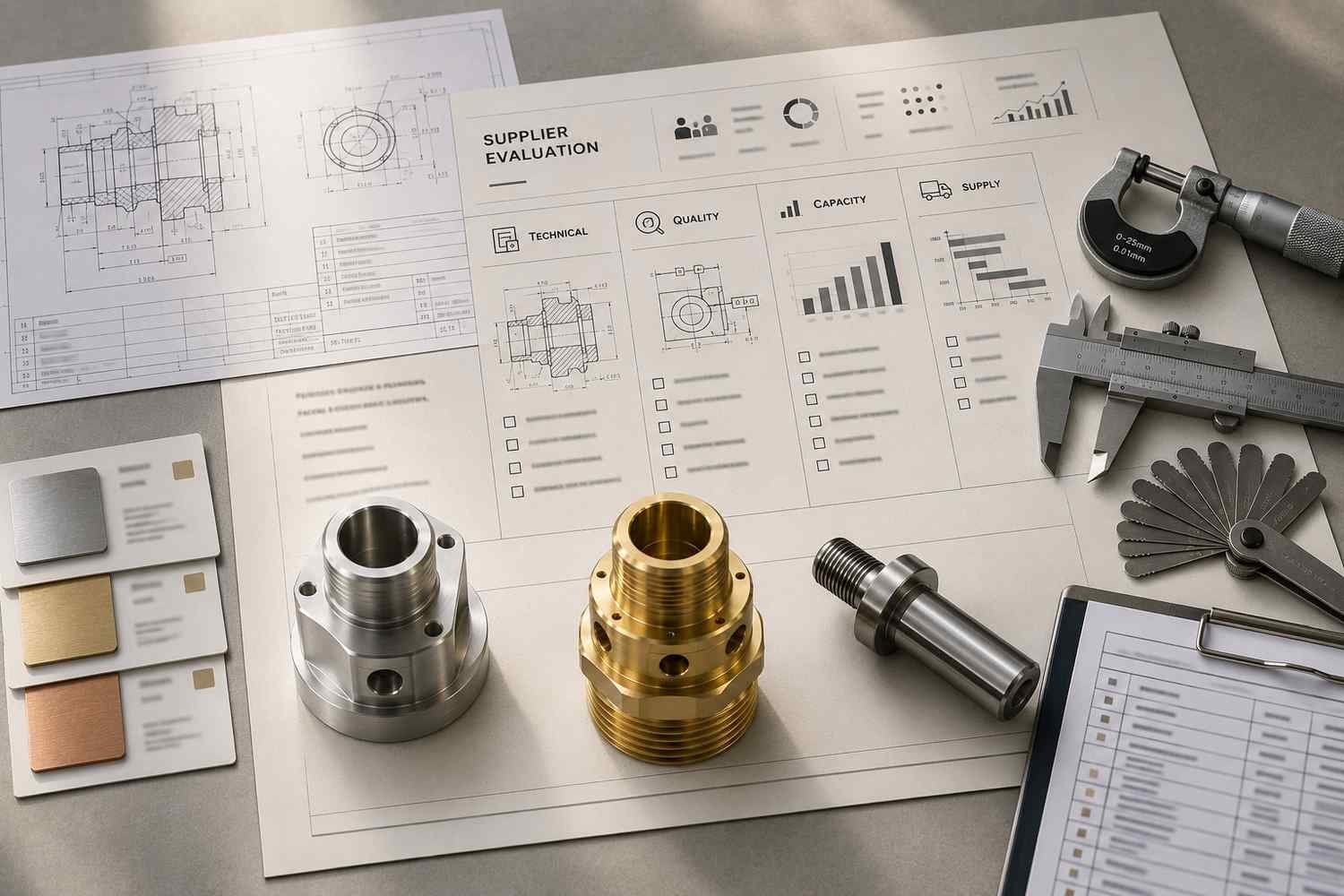
OEM buyers should evaluate an Indian supplier across technical capability, quality, capacity, material control, delivery, documentation and commercial reliability rather than selecting a supplier on unit price alone.
A practical supplier evaluation framework is:
| Area | Questions for the supplier |
|---|---|
| Manufacturing | Can the component be produced consistently to drawing? |
| Materials | Can the specified material and grade be sourced reliably? |
| Tolerances | Can critical dimensions be maintained in repeat production? |
| Quality | What quality-management system is used? |
| Inspection | How are critical characteristics verified? |
| Capacity | Can the supplier support the annual programme volume? |
| Traceability | Can batches, materials and production records be traced? |
| Development | Can samples be developed within the required timeline? |
| Delivery | Can the supplier maintain the required delivery schedule? |
| Export | Can the supplier manage international shipping documentation? |
| Engineering | Can the supplier respond to drawing or process changes? |
| Commercial | What is the total landed cost, not just the piece price? |
This framework is especially useful when evaluating smaller and mid-sized suppliers.
What quality documents should an OEM request from an Indian component supplier?
The exact documentation depends on the customer, component and applicable quality requirements, but an OEM buyer should establish the required quality and traceability documentation before approving a supplier.
Depending on the programme, buyers may request:
- Material certificates
- Inspection reports
- Process documentation
- Control plans
- Process flow documentation
- First Article Inspection records
- PPAP documentation where required
- Batch or lot traceability
- Dimensional inspection records
- Certificates relevant to the customer’s specification
The supplier should not simply say that documents are “available.”
The buyer should establish:
What document?
At what stage?
For which batch?
Who approves it?
How long is it retained?
That is how documentation becomes part of a controlled supply chain rather than an administrative exercise.
What is the difference between an Indian supplier and an OEM-ready Indian supplier?
An OEM-ready supplier is not defined by the country in which it operates; it is defined by whether it can consistently satisfy the customer’s technical, quality and commercial requirements.
This distinction is important.
Two Indian manufacturers may produce similar components.
Supplier A may have:
- Suitable machines
- Competitive pricing
- Basic inspection
Supplier B may have:
- Controlled processes
- Documented inspection
- Material traceability
- Defined production controls
- Sample-development capability
- Customer-specific documentation
- Export experience
The second supplier may be more suitable for an OEM programme even if its quoted price is not the lowest.
That is why procurement teams should evaluate total supplier capability, not just quotation value.
How important is manufacturing capacity when selecting an Indian supplier?
Capacity matters because a supplier that can manufacture a sample may not necessarily be able to support stable serial production.
The buyer should distinguish between:
Prototype capability
and
serial-production capability.
A useful capacity review includes:
- Available machines
- Machine utilisation
- Number of production shifts
- Bar-feeding or automation capability where relevant
- Secondary operations
- Inspection capacity
- Maintenance system
- Skilled manpower
- Raw-material availability
- Production planning
- Bottleneck processes
The buyer should also ask what happens when the required volume increases.
A supplier may successfully produce 5,000 pieces per month but struggle with 50,000.
Capacity should therefore be evaluated against the actual programme requirement, not against a generic statement such as “we have sufficient capacity.”
What role does localisation play in India’s automotive supply chain?
Localisation is becoming increasingly important because India’s automotive policies are designed to deepen domestic manufacturing and reduce dependence on imported advanced technologies.
The Ministry of Heavy Industries reported in July 2026 that the PLI-Auto scheme had generated cumulative investment of ₹44,326 crore, incremental sales of ₹52,414 crore and employment of 67,820 through 31 March 2026.
The PLI-Auto scheme has a budgetary outlay of ₹25,938 crore and is designed to promote Advanced Automotive Technology products, deep localisation and domestic and global supply-chain development.
The scheme also requires a minimum 50% Domestic Value Addition for applicants to receive incentives.
For buyers, the implication is not that every component is already locally manufactured.
It is that India’s manufacturing ecosystem is being pushed toward deeper domestic value creation.
Does localisation mean India no longer depends on imported components?
No. India still imports substantial volumes of automotive components, particularly advanced and specialised technologies.
In FY2025–26, India’s component imports increased about 13% to US$25.4 billion, exceeding exports of approximately US$24 billion and resulting in a trade deficit of about US$1.37 billion.
Reporting based on ACMA data indicates that higher imports were linked partly to demand for advanced technologies, EV-related components and specialised products.
This is actually important for procurement teams.
It shows where India’s sourcing ecosystem is already strong and where further localisation may still be developing.
A buyer should therefore avoid assuming:
“India can manufacture everything.”
A better question is:
“Which parts of my supply chain can be competitively and reliably manufactured in India today?”
That question leads to a much more useful sourcing exercise.
What does the EV transition mean for Indian component sourcing?
The EV transition is increasing demand for new component categories while also exposing areas where India remains dependent on imported technology and specialised parts.
ACMA-related reporting indicates that EV components represented approximately 4.6% of domestic OEM supplies in FY2025–26, excluding lithium-ion batteries.
At the same time, the industry continues to work on localisation of EV-related components.
This creates two different sourcing opportunities.
Opportunity 1: Existing mechanical components
Many EVs still require precision-manufactured mechanical, electrical and structural components.
Examples can include:
- Precision turned parts
- Bushings
- Pins
- Fasteners
- Terminals
- Connectors
- Shafts
- Housings
- Mounting components
Opportunity 2: New EV-specific components
The transition also creates demand for components associated with:
- Power electronics
- Motors
- Charging systems
- Thermal systems
- Battery systems
- Electronic controls
However, the localisation level varies significantly by component.
Therefore, an OEM buyer should assess the specific part and technology, rather than treating “EV components” as one category.
Why are electrical and electronic components strategically important?
Electrical and electronic components are becoming increasingly important to automotive supply chains, but they are also an area where India still has meaningful import dependence.
The FY2025–26 trade deficit in auto components was partly associated with increasing demand for advanced technology and EV-related components.
For procurement teams, this creates a useful distinction.
Mechanical precision components may be sourced through established machining and metal-forming supply chains.
Electronic and semiconductor-intensive products can have very different:
- Technology requirements
- Capital requirements
- Qualification cycles
- Material requirements
- Supplier dependencies
That means an OEM should segment its sourcing strategy by component type.
Do not use the same supplier-qualification model for a precision machined brass connector and a semiconductor-based power-control module.
What materials can Indian precision-component suppliers manufacture?
Indian manufacturers serve automotive and industrial applications using materials including brass, copper, aluminium, steel and stainless steel, but buyers should verify the exact material, grade, process and specification for each component.
For precision metal components, the material decision affects:
- Machinability
- Conductivity
- Strength
- Corrosion resistance
- Weight
- Surface treatment
- Dimensional stability
- Cost
A strong RFQ should therefore specify the material grade rather than simply saying:
“steel component.”
For example, the supplier needs to know the applicable grade, mechanical requirements and any customer-specific material standard.
How should a European or global OEM send an RFQ to an Indian supplier?
A detailed RFQ should contain the engineering, commercial and quality information necessary for the supplier to determine manufacturing feasibility and provide a reliable quotation.
At minimum, provide:
- Component drawing
- Drawing revision
- Material and grade
- Annual volume
- Monthly or batch volume
- Critical tolerances
- Surface-finish requirements
- Inspection requirements
- Applicable standards
- Packaging requirements
- Delivery location
- Development timing
- Required documentation
- Expected production start date
A better RFQ produces a better supplier comparison.
Without these details, buyers may end up comparing quotations based on different assumptions.
What should an OEM ask an Indian supplier before approving them?
The buyer should ask for evidence of the supplier’s ability to manufacture the specific component consistently, rather than relying only on a company presentation.
Useful questions include:
- Have you manufactured a similar component?
- What material do you normally process?
- What tolerances can you maintain consistently?
- How is the component inspected?
- How is material traceability maintained?
- How are process changes controlled?
- What happens if demand increases?
- What is your sample-development process?
- What quality documentation can you provide?
- What is your typical production lead time?
- How do you manage preventive maintenance?
- How are non-conforming parts controlled?
- What export documentation can you support?
The strongest suppliers should be able to answer these questions with evidence rather than marketing language.
Is price the most important factor when sourcing auto components from India?
No. Unit price is important, but it should not be the only sourcing criterion.
A buyer should calculate:
Unit price
Tooling
Packaging
Freight
Duties/taxes where applicable
Quality costs
Inspection
Supplier-development cost
Inventory cost
Potential disruption cost
=
Total landed cost
A supplier offering a lower unit price can become more expensive if it creates:
- Higher rejection rates
- Late deliveries
- Repeated quality problems
- Excessive inspection
- Emergency freight
- Production stoppages
The right procurement decision is therefore based on total cost and supply risk, not quotation price alone.
What is the outlook for India’s auto-component industry in FY2027?
ACMA expects the Indian auto-component industry to grow approximately 8–10% in FY2026–27, although geopolitical conditions, labour availability, working-capital pressure and supply-chain risks remain important variables.
Industry representatives have identified labour shortages, raw-material volatility, geopolitical disruptions and working-capital pressure as challenges for suppliers, particularly smaller manufacturers.
That means the opportunity is real, but procurement teams should not assume uninterrupted growth.
Supplier resilience still matters.
A sourcing team should ask:
Can the supplier continue supplying us if raw-material prices rise?
Can they maintain production if demand increases?
Can they manage a temporary logistics disruption?
Do they have alternative sources for critical inputs?
These questions are increasingly relevant to global procurement.
What does this mean for OEM and Tier-1 sourcing from India?
The strongest opportunity is not simply finding a cheaper supplier; it is building a qualified Indian supply base that can meet global requirements consistently.
The current market signals are strong:
- Industry turnover has reached US$85.9 billion.
- OEM supplies grew 16.3%.
- Exports reached US$24 billion.
- Europe grew 9% as an export market.
- PLI-Auto is supporting deeper localisation.
- Global manufacturers are expanding sourcing from India.
- At the same time, imports and advanced-technology dependence remain significant.
That combination creates a more nuanced sourcing opportunity.
India is not simply a low-cost manufacturing location.
It is becoming a more integrated manufacturing and sourcing base, while still having gaps that buyers need to understand.
What does this mean for Premi Brasscom International?
For buyers looking for precision metal components in automotive, electrical, electronic and industrial applications, the relevant question is whether a supplier can manufacture the specific component to the required drawing, material, quality and volume requirements.
Premi Brasscom International manufactures precision metal components using materials including brass, copper, aluminium, steel and stainless steel for automotive, electrical, electronic and industrial applications.
The practical sourcing process should be straightforward:
Drawing / RFQ
↓
Manufacturing-feasibility review
↓
Material and process evaluation
↓
Quotation
↓
Sample development
↓
Inspection
↓
Customer approval
↓
Production
↓
Repeat supply
For an OEM or Tier-1 buyer, this is a better starting point than making a sourcing decision from a generic supplier directory.
The buyer can begin with the actual component.
Frequently Asked Questions About Indian Auto Component Suppliers
What is the size of India’s auto-component industry in 2026?
India’s auto-component industry reached ₹7.60 lakh crore (US$85.9 billion) in FY2025–26, growing 12.7% year on year.
How much does India export in auto components?
India exported approximately US$24 billion of automotive components in FY2025–26, up about 5% from the previous year.
How much does India export to Europe?
Indian auto-component exports to Europe reached approximately US$7.36 billion in FY2025–26 and grew 9% during the year.
Are Indian auto-component suppliers suitable for OEM sourcing?
Some are, but suitability must be established through supplier qualification. Buyers should evaluate technical capability, quality, capacity, traceability, documentation, delivery and total landed cost.
What should OEM buyers check before selecting an Indian supplier?
OEM buyers should check manufacturing capability, material control, quality systems, inspection, traceability, production capacity, development capability, export readiness and delivery performance.
Is India dependent on imported auto components?
Yes. India’s auto-component imports reached approximately US$25.4 billion in FY2025–26, exceeding exports and creating a trade deficit of about US$1.37 billion.
Why did India’s auto-component trade deficit increase?
Imports grew faster than exports, partly because demand for advanced technologies, EV-related components and specialised products increased.
What is PLI-Auto?
PLI-Auto is India’s Production Linked Incentive scheme for automobiles and auto components, designed to promote Advanced Automotive Technology manufacturing, deep localisation and domestic and global supply-chain development.
How much investment has PLI-Auto generated?
The Ministry of Heavy Industries reported ₹44,326 crore of cumulative investment under PLI-Auto through 31 March 2026. It also reported ₹52,414 crore of incremental sales and 67,820 jobs generated.
Does PLI-Auto require domestic value addition?
Yes. The scheme requires a minimum 50% Domestic Value Addition for incentives under the scheme.
Does localisation mean India can manufacture every automotive component?
No. India still imports significant quantities of advanced and specialised components, particularly in areas affected by EV and electronics technology requirements.
What components can Indian precision manufacturers supply?
Depending on the supplier’s capabilities, Indian manufacturers can produce precision metal components such as turned parts, shafts, pins, bushings, terminals, connectors and other components in materials including brass, copper, aluminium, steel and stainless steel.
What should an RFQ for an Indian component supplier contain?
An RFQ should ideally include the drawing, revision, material grade, annual volume, batch quantity, critical tolerances, surface finish, inspection requirements, applicable standards, packaging and delivery requirements.
Is unit price enough to compare Indian suppliers?
No. Buyers should compare total landed cost, quality performance, delivery reliability, development costs, tooling, freight and supply risk as well as the quoted unit price.
What is the expected growth of India’s auto-component industry in FY2027?
ACMA expects approximately 8–10% growth in FY2026–27, although geopolitical, labour, raw-material and supply-chain risks remain.
Why should European OEMs consider Indian component suppliers?
India combines a large automotive manufacturing ecosystem with growing exports, increasing global sourcing interest and expanding trade integration. However, each supplier must still pass the buyer’s technical and commercial qualification process.
Conclusion
India’s auto-component industry is becoming more relevant to global procurement, but the strongest suppliers will compete on capability and reliability rather than price alone.
FY2025–26 produced several important signals.
The industry reached ₹7.60 lakh crore (US$85.9 billion) in turnover, OEM supplies increased 16.3%, exports reached approximately US$24 billion, and exports to Europe increased 9% to US$7.36 billion.
At the same time, India’s imports rose faster than exports, creating a trade deficit of approximately US$1.37 billion. That demonstrates that localisation is progressing but remains incomplete, particularly in advanced technologies and specialised components.
Government policy is also pushing the supply chain toward deeper localisation. PLI-Auto had generated ₹44,326 crore of investment through March 2026 and is designed to support advanced automotive technology manufacturing and domestic and global supply-chain development.
For OEM and Tier-1 procurement teams, the takeaway is simple:
Do not ask only whether India is competitive.
Ask:
Which components can India manufacture competitively?
Which suppliers can meet our technical requirements?
Which suppliers can support our volumes?
Which suppliers can provide the required quality and traceability?
Which suppliers can become reliable long-term partners?
That is where the real opportunity lies.
Premi Brasscom International manufactures precision metal components in brass, copper, aluminium, steel and stainless steel for automotive, electrical, electronic and industrial applications.
For an OEM, Tier-1 supplier or industrial buyer evaluating an Indian precision-component source, the best starting point is the actual requirement: share the component drawing, material specification or RFQ for a manufacturing-feasibility evaluation.
Ministry of Heavy Industries — PLI-Auto
Ministry of Heavy Industries — PLI-Auto Scheme
Use for:
- ₹25,938 crore scheme
- FY2022–23 to FY2026–27
- advanced automotive technology
- localisation
- global supply-chain objective
PIB — July 2026 PLI-Auto update
PIB — PLI Scheme for Automobile and Auto Component Industry, 21 July 2026
Use for:
- ₹44,326 crore investment
- ₹52,414 crore incremental sales
- 67,820 employment
- 50% DVA
- 154 products/variants with DVA certificates
ACMA industry data
ACMA — Indian Auto Component Industry Overview
Use for established ACMA industry context.
FY2025–26 ACMA data
Autocar Professional — ACMA Auto Component Export Review 2026
Use for:
- US$24B exports
- Europe +9%
- US$7.36B Europe exports
- global sourcing
- European procurement expansion
FY2025–26 industry performance
Business Standard — Indian Auto Component Industry FY26
Use for:
- ₹7.60T turnover
- US$85.9B
- 12.7% growth
- five-year growth
FY27 outlook
ETAuto — Indian Auto Component FY27 Outlook
Use for:
- 8–10% FY27 outlook
- labour shortages
- supply-chain risk
- working-capital pressure
- localisation challenges