
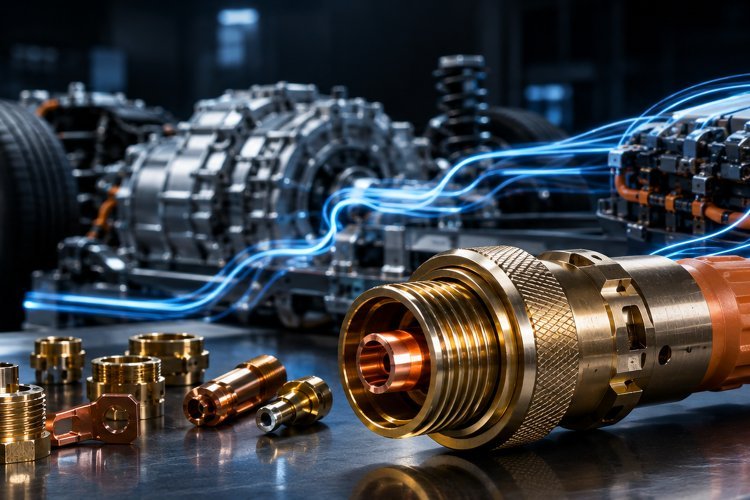
Key takeaway: India’s electric vehicle industry is expanding rapidly, but localisation is still uneven across the EV component supply chain. While structural and mechanical components have achieved stronger domestic manufacturing, areas such as motors, battery systems, power electronics and charging systems still face localisation challenges. This creates opportunities for capable Indian precision metal component manufacturers to support the growing EV ecosystem.
India’s electric mobility transition is no longer only a vehicle-adoption story.
It is becoming a manufacturing and supply-chain story.
As electric vehicle production increases, automotive OEMs and Tier-1 suppliers need reliable suppliers for an increasingly complex mix of mechanical, electrical and electronic components.
For Indian manufacturers, this creates an important opportunity:
Can domestic precision component manufacturers become part of the next generation of India’s EV supply chain?
What Is EV Component Localisation?
EV component localisation is the process of manufacturing and sourcing electric-vehicle components within the domestic supply chain instead of relying primarily on imported components.
Localisation can involve everything from structural and mechanical components to electrical connectors, terminals, motor components, battery-related hardware, power-electronics components and charging-system parts.
The objective is not simply to manufacture more components in India.
It is to create a supply chain with sufficient:
- Manufacturing capability
- Quality
- Technical expertise
- Production capacity
- Cost competitiveness
- Domestic value addition
- Supply reliability
The Government of India has been supporting the EV ecosystem through measures including FAME, the Production Linked Incentive scheme for Advanced Chemistry Cells, battery localisation initiatives and state-level EV policies.
Why Is EV Localisation Important for India?
India’s EV transition creates opportunities beyond vehicle assembly.
A vehicle manufacturer depends on an extensive network of suppliers.
As vehicle architectures change, the component mix changes as well.
Electric vehicles require greater integration of electrical, electronic and software-driven systems alongside conventional mechanical components.
This makes the development of a domestic supplier ecosystem increasingly important.
A June 2026 assessment by IEEFA found that India’s EV localisation progress remains uneven. Components aligned with established automotive manufacturing capabilities—including chassis systems, structural parts, wiring harnesses and thermal systems—show stronger domestic manufacturing, while EV-specific areas such as motors, battery packs, power electronics and charging systems continue to face localisation gaps.
This distinction is important for component manufacturers.
The opportunity is not to manufacture every EV component.
The opportunity is to identify the areas where a company’s existing precision manufacturing capabilities can solve genuine supply-chain requirements.
Which EV Components Can Require Precision Metal Parts?
Not every EV component is electronic.
Many systems still depend on accurately manufactured metal components.
Depending on the application and engineering specification, precision metal parts can be relevant to:
- Electrical connectors
- Terminals
- Bushes
- Pins
- Inserts
- Fasteners
- Conductive components
- Motor-related hardware
- Charging-system hardware
- Sensor-related assemblies
- Battery-system hardware
- Precision mounting components
- Custom machined components
The exact material and manufacturing process depend on the component’s design and application.
For example, brass and copper can be relevant where electrical conductivity and machinability are required, while aluminium and steel can serve different mechanical and structural requirements.
Why Are Brass and Copper Important in the EV Supply Chain?
Material selection is application-specific, but electrical systems create opportunities for conductive metal components.
Brass
Brass combines useful machinability with corrosion resistance and electrical conductivity.
Depending on the engineering requirement, precision brass components can be used for terminals, connectors, inserts, threaded components and other electrical or mechanical applications.
Copper
Copper is particularly relevant where electrical conductivity is critical.
As EV architectures become increasingly electrified, copper components can have applications in electrical connections and related assemblies.
Aluminium
Aluminium can be useful where weight reduction is important because of its relatively low density.
Depending on the design, precision aluminium components can support lightweight automotive and electrical applications.
Steel and Stainless Steel
Steel and stainless steel can provide mechanical strength, durability and application-specific corrosion resistance.
The appropriate material should always be determined from the customer’s engineering drawing, specification and operating conditions.
What Does EV Growth Mean for Indian Precision Component Manufacturers?
EV manufacturing does not automatically mean that every traditional automotive supplier will become an EV supplier.
The transition changes the requirements.
A manufacturer needs to understand where its existing processes and capabilities fit into the new architecture.
For a precision metal component manufacturer, relevant capabilities can include:
- Precision machining
- Consistent dimensional control
- Material flexibility
- Repeat production
- Inspection and quality control
- Custom component development
- Production scalability
- Reliable delivery
This is where established manufacturing experience can become valuable.
The supplier does not necessarily need to manufacture a complete EV system.
It may instead supply a small but important component that becomes part of a larger Tier-1 or OEM assembly.
What Should EV OEMs and Tier-1 Suppliers Look for in a Metal Component Supplier?
EV procurement teams should evaluate more than unit price.
A supplier should be assessed against the complete production requirement.
| Evaluation factor | Why it matters |
|---|---|
| Material capability | Ensures the required material can be processed correctly |
| Machining capability | Determines whether the component geometry can be manufactured |
| Dimensional consistency | Supports reliable downstream assembly |
| Inspection capability | Helps verify critical dimensions and specifications |
| Production capacity | Determines whether the supplier can support required volumes |
| Traceability | Supports quality investigation and production control |
| Delivery capability | Reduces supply-chain disruption |
| Custom manufacturing | Supports drawing- and application-specific components |
| Quality systems | Provides structured process control |
For EV programmes, supplier qualification is particularly important because new component architectures may involve tighter technical requirements and new quality expectations.
Is EV Localisation Only About Batteries?
No. EV localisation extends far beyond battery cells and battery packs.
The wider EV ecosystem includes:
- Motors
- Power electronics
- Charging systems
- Electrical connectors
- Wiring systems
- Thermal systems
- Structural components
- Control systems
- Precision mechanical components
- Battery-related hardware
IEEFA’s 2026 assessment specifically highlights the uneven localisation of EV components and identifies motors, battery packs, power electronics and charging systems among areas where deeper localisation remains challenging.
This creates an important distinction for Indian suppliers:
Localisation does not require every company to manufacture the entire EV system.
It requires manufacturers across the supply chain to develop competitive capabilities in the component categories where they can add value.
How Can Indian Precision Metal Manufacturers Support EV Localisation?
A precision metal manufacturer can support EV localisation by becoming a reliable supplier of customised components for OEMs, Tier-1 suppliers and other industrial manufacturers.
This can include manufacturing components according to:
- Customer drawings
- Samples
- Material specifications
- Dimensional tolerances
- Surface-finish requirements
- Production-volume requirements
- Application-specific requirements
The ability to repeatedly manufacture a component to specification can be more important than simply producing an initial sample.
For OEM and Tier-1 procurement teams, the objective is a supplier capable of supporting the complete production cycle.
How Is Premi Brasscom Positioned for the EV Supply Chain?
Premi Brasscom International has been manufacturing and exporting metal components since 1984.
The company’s product portfolio includes components manufactured from:
- Brass
- Copper
- Aluminium
- Stainless steel
- Mild steel
The catalogue covers automotive, electrical, electronic, fastener, pneumatic, sanitary, LPG, transformer and other component categories.
The company also holds IATF 16949:2016 and ISO 9001:2015 certifications, providing an established quality-system foundation for automotive and industrial applications.
For EV-related applications, the relevant opportunity is not to claim that every Premi Brasscom component is automatically an EV component.
Instead, the focus should be on identifying specific customer requirements where precision brass, copper, aluminium, stainless-steel or mild-steel components can support electric-mobility assemblies.
That is the technically honest way to position the company.
What Should Buyers Ask Before Selecting an EV Component Supplier?
Before approving a precision metal component supplier for an EV-related application, procurement and engineering teams should ask:
- Can the supplier manufacture the required material?
- Can it meet the component’s dimensional requirements?
- Can it maintain consistency during repeat production?
- Does it have appropriate inspection processes?
- Can it support the required production volume?
- Can it manufacture according to drawings or samples?
- Does it maintain production traceability?
- Can it meet the required delivery schedule?
- Does its quality system match the application’s requirements?
- Can the supplier scale with the programme?
These questions help move supplier selection away from a simple price comparison and toward total supply-chain capability.
The Opportunity for India’s EV Supply Chain
India’s EV transition is creating a new industrial ecosystem.
The country has established automotive manufacturing capabilities, but deeper localisation will require continued development across the component value chain.
The opportunity for Indian precision manufacturers lies particularly in areas where their existing capabilities can be adapted to emerging EV requirements.
That means the future of EV manufacturing in India will not be determined only by battery plants or vehicle assembly facilities.
It will also depend on the thousands of suppliers manufacturing the components that make those systems work.
Frequently Asked Questions
What is EV component localisation?
EV component localisation is the development and sourcing of electric-vehicle components within India’s domestic manufacturing ecosystem instead of relying primarily on imports.
Why is EV component localisation important?
Localisation can strengthen domestic supply chains, increase domestic value addition and reduce dependence on imported components while creating opportunities for Indian manufacturers.
What metal components are used in EVs?
Depending on the application, EV systems can use precision brass, copper, aluminium, steel and stainless-steel components such as terminals, connectors, inserts, pins, bushes, fasteners and custom machined parts.
Are brass components used in electric vehicles?
Brass can be used in selected electrical and mechanical applications where its combination of machinability, corrosion resistance and electrical conductivity is suitable for the engineering requirement.
Are copper components important for EVs?
Copper is important in applications where electrical conductivity is required. Its suitability for a specific component depends on the electrical, mechanical, thermal and manufacturing requirements.
Can Indian precision component manufacturers support EV OEMs?
Yes. Indian precision manufacturers can support EV supply chains where their materials, machining processes, quality systems, production capacity and technical capabilities match the OEM or Tier-1 component requirement.
Conclusion
EV localisation in India is bigger than battery manufacturing.
The next phase of the transition will depend on how effectively India develops the wider component ecosystem—including electrical, electronic, mechanical and precision-manufactured components.
For OEMs and Tier-1 suppliers, this means identifying domestic suppliers that can provide consistent quality, technical capability, production scalability and reliable delivery.
For Indian precision metal manufacturers, it creates an opportunity to apply existing manufacturing capabilities to the emerging electric-mobility supply chain.
Premi Brasscom International can support customised brass, copper, aluminium, stainless-steel and mild-steel component requirements for automotive, electrical and industrial applications.
If you have an EV-related component drawing, sample or sourcing requirement, contact Premi Brasscom International to discuss the manufacturing requirement.