
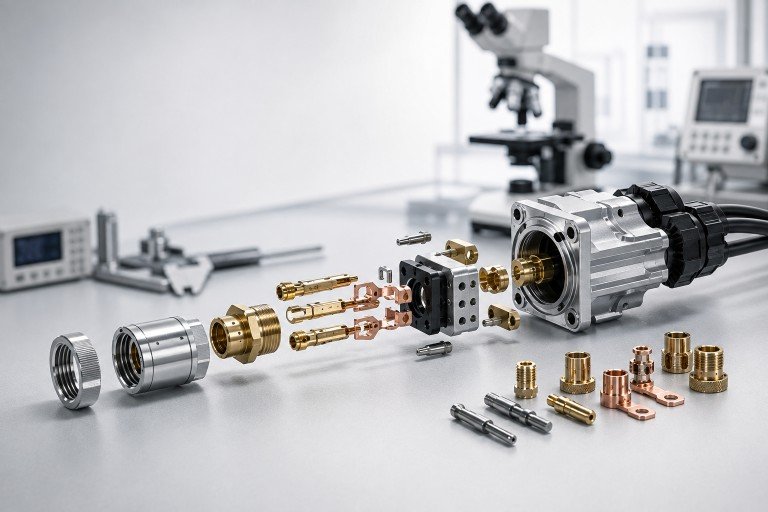
Key takeaway: India is moving beyond electronics assembly toward deeper domestic component manufacturing. Government support for electro-mechanical components, passive components, PCBs and upstream supply-chain manufacturing is creating new opportunities for Indian precision metal manufacturers supplying electrical, electronic, automotive and industrial applications.
India’s electronics manufacturing industry is entering a more important stage.
For years, much of the focus was on increasing the production and export of finished electronic products.
The next challenge is deeper in the supply chain:
Can India manufacture more of the components that go inside those products?
This question matters to OEMs, electronics manufacturers, automotive suppliers and procurement teams because many electronic systems depend on thousands of small mechanical and electro-mechanical parts.
For precision metal component manufacturers, this creates a potential opportunity.
What Is Electronics Component Manufacturing?
Electronics component manufacturing involves producing the individual components and sub-assemblies that are used to build electronic products and systems.
These can include electrical, electro-mechanical and mechanical components such as:
- Connectors
- Terminals
- Contact components
- Metal inserts
- Enclosures
- Precision fasteners
- Bushes
- Pins
- Conductive components
- Machined metal parts
- Other application-specific components
India’s Electronics Component Manufacturing Scheme (ECMS) specifically targets categories including non-SMD passive components, electro-mechanicals, multi-layer PCBs, enclosures and parts/components used within the electronics supply chain.
This is important because it moves the conversation from simply assembling electronic products toward building more of the underlying supply chain domestically.
Why Is India Focusing on Electronics Component Localisation?
India has significantly increased its electronics manufacturing capacity over the past decade.
According to the Government of India, domestic production of electronic goods increased from approximately ₹1.90 lakh crore in FY2014–15 to ₹9.52 lakh crore in FY2023–24. Electronic-goods exports increased from approximately ₹0.38 lakh crore to ₹2.41 lakh crore over the same period.
But finished-product manufacturing is only one part of the value chain.
A strong manufacturing ecosystem also requires domestic capabilities for:
Materials → Components → Sub-assemblies → Systems → Finished Products
The ECMS is designed to strengthen that deeper component ecosystem and increase domestic value addition.
What Does the Electronics Component Manufacturing Scheme Cover?
The ECMS is particularly relevant because its target segments extend into areas that require precision manufacturing.
The scheme covers categories including:
| Component area | Potential manufacturing relevance |
|---|---|
| Electro-mechanicals | Mechanical + electrical component integration |
| Passive components | Components used in electronic circuits |
| Multi-layer PCBs | Electronic circuit infrastructure |
| Enclosures | Protective mechanical structures |
| Supply-chain components | Parts used to manufacture electronic sub-assemblies |
| Capital equipment components | Manufacturing infrastructure |
The scheme was designed to attract domestic and global investment, increase domestic value addition and integrate Indian companies into global value chains.
For precision metal manufacturers, electro-mechanical and supply-chain component categories are particularly interesting.
Why Do Electronics Manufacturers Need Precision Metal Components?
Electronic systems are not made entirely from semiconductors and circuit boards.
Many products also require precisely manufactured physical components.
These components may provide:
- Electrical contact
- Mechanical support
- Connection
- Alignment
- Mounting
- Threading
- Heat-management interfaces
- Structural protection
- Assembly interfaces
The required component may be very small, but dimensional consistency can still be critical.
For example, a connector or terminal may need precise dimensions to ensure reliable mating and electrical contact.
Similarly, a threaded insert or precision machined housing component may need to maintain consistent dimensions throughout production.
This is where precision manufacturing becomes part of the electronics supply chain.
Which Metals Can Be Used in Electronic and Electrical Components?
Material selection depends on the application, engineering requirements and environmental conditions.
Brass
Brass can be suitable for applications requiring a combination of machinability, corrosion resistance and electrical conductivity.
Potential applications include selected terminals, connectors, inserts and other precision components.
Copper
Copper is particularly important where electrical conductivity is a major requirement.
Copper components can therefore be relevant to electrical connections and other conductive applications.
Aluminium
Aluminium can be useful where low density and machinability are important.
Depending on the application, aluminium can be used for housings, mechanical components and other precision parts.
Stainless Steel
Stainless steel can provide strength and corrosion resistance for applications where environmental durability is important.
Mild Steel
Mild steel can be suitable for various mechanical and industrial applications where its mechanical properties and cost profile match the requirement.
The correct material should always be selected according to the customer’s drawing, specification and application—not simply based on material popularity.
What Does Electronics Localisation Mean for Automotive Suppliers?
This development is not limited to smartphones and consumer electronics.
The Government’s ECMS approvals include products with cross-sector applications in automotive, telecom, consumer electronics, strategic electronics and IT hardware.
That makes electronics localisation particularly relevant to the automotive industry.
Modern vehicles increasingly depend on:
- Electrical systems
- Electronic control systems
- Sensors
- Connectors
- Terminals
- Wiring systems
- Power electronics
- Communication systems
The transition toward electric and software-defined vehicles increases this integration further.
This creates an overlap between two supply chains:
Automotive manufacturing + electronics manufacturing
For precision metal suppliers, that overlap can create opportunities for components used in electrical and electronic automotive assemblies.
What Should OEMs Look for in a Precision Metal Component Supplier?
A procurement team should not evaluate a component supplier only on price.
For electronics and automotive applications, the supplier should be evaluated across several dimensions.
1. Material capability
Can the supplier manufacture the required material according to specification?
2. Dimensional capability
Can the supplier consistently manufacture the required dimensions and tolerances?
3. Production repeatability
Can the supplier reproduce the same component across repeated production batches?
4. Inspection capability
Does the supplier have appropriate inspection processes for dimensions, threads, surface finish and other critical characteristics?
5. Production capacity
Can the supplier support the required production volume?
6. Traceability
Can production batches and inspection information be traced when required?
7. Delivery reliability
Can the supplier consistently meet agreed delivery schedules?
8. Custom manufacturing
Can the supplier manufacture according to engineering drawings, samples and customer-specific requirements?
These factors become particularly important when a component enters an OEM or Tier-1 supply chain.
How Can Precision Metal Manufacturers Support Electronics Localisation?
Precision metal manufacturers can contribute to localisation without manufacturing complete electronic products.
Their role can be much more focused.
A manufacturer may supply a specific component that becomes part of:
A connector
→ An electronic assembly
→ An automotive system
→ An industrial machine
→ A finished product
This is one of the most important points for procurement teams to understand.
A supplier does not need to manufacture the complete product to create value within the supply chain.
Specialised component manufacturing can itself become a critical part of localisation.
What Is the Opportunity for Indian Precision Component Manufacturers?
The government’s electronics manufacturing initiatives are designed to increase domestic value addition and integrate Indian companies into global value chains.
At the same time, India’s electronics and engineering exports are becoming increasingly important.
India’s July 2026 goods exports reached a record $44.24 billion, with electronics and engineering goods among the major contributors.
That creates an opportunity for Indian component manufacturers to move beyond serving only domestic customers.
The potential customer base includes:
- Electronics OEMs
- EMS companies
- Automotive Tier-1 suppliers
- Electrical manufacturers
- Industrial equipment manufacturers
- Telecom equipment manufacturers
- Export-oriented manufacturers
How Is Premi Brasscom International Positioned?
Premi Brasscom International has been manufacturing and exporting metal components since 1984.
Its product portfolio includes components manufactured from:
- Brass
- Copper
- Aluminium
- Stainless steel
- Mild steel
The company’s catalogue covers automotive, electrical, electronic, fastener, pneumatic, sanitary, LPG, transformer and other component categories.
Premi Brasscom also holds IATF 16949:2016 and ISO 9001:2015 certifications.
This provides a relevant manufacturing foundation for customers looking for precision metal components for automotive, electrical, electronic and industrial applications.
However, the right way to evaluate suitability is always component-specific.
An OEM or Tier-1 supplier should provide the drawing, sample, material specification and application requirements so the manufacturer can determine whether the component can be produced to the required specification.
What Questions Should Buyers Ask Before Selecting an Electronics Component Supplier?
Before approving a precision metal supplier, procurement and engineering teams should ask:
Can the supplier manufacture the required material?
Can it consistently meet the specified dimensions?
Can it support the required production volume?
Does it have appropriate inspection capability?
Can it manufacture according to drawings or samples?
Does it maintain production traceability?
Can it support repeat orders reliably?
Does its quality system match the application’s requirements?
These questions help buyers evaluate the supplier based on total manufacturing capability rather than unit price alone.
Frequently Asked Questions
What is electronics component localisation in India?
Electronics component localisation means increasing the domestic manufacturing and sourcing of components used within India’s electronics supply chain rather than depending primarily on imported components.
What components are covered by India’s ECMS?
The ECMS includes categories such as electro-mechanicals, passive components, multi-layer PCBs, enclosures, supply-chain components and selected manufacturing equipment components.
Are metal components used in electronics manufacturing?
Yes. Electronic products and systems can require metal components for electrical connections, mechanical support, mounting, alignment, enclosures and other functions.
Are brass components used in electrical applications?
Brass can be used in selected electrical applications where its combination of machinability, corrosion resistance and electrical conductivity meets the engineering requirements.
Are copper components important for electronics?
Copper is widely relevant to applications requiring electrical conductivity. The exact component design and material specification determine whether copper is appropriate.
Can automotive suppliers benefit from electronics localisation?
Yes. ECMS-supported component categories have cross-sector applications that include automotive products, creating potential overlap between electronics and automotive supply chains.
What should an OEM consider when selecting a precision metal supplier?
OEMs should evaluate manufacturing capability, material capability, dimensional consistency, inspection, production capacity, traceability, delivery reliability and the supplier’s ability to manufacture according to customer specifications.
Conclusion
India’s electronics manufacturing strategy is moving deeper into the component supply chain.
Government support for electro-mechanical components, passive components, PCBs, enclosures and upstream manufacturing is intended to increase domestic value addition and strengthen India’s position in global electronics supply chains.
For OEMs and Tier-1 suppliers, this creates an opportunity to develop stronger domestic supplier networks.
For precision metal manufacturers, it creates another potential market beyond traditional industrial applications.
The opportunity is particularly relevant where electrical, electronic and mechanical requirements intersect.
Premi Brasscom International manufactures customised brass, copper, aluminium, stainless-steel and mild-steel components for automotive, electrical, electronic and industrial applications.