
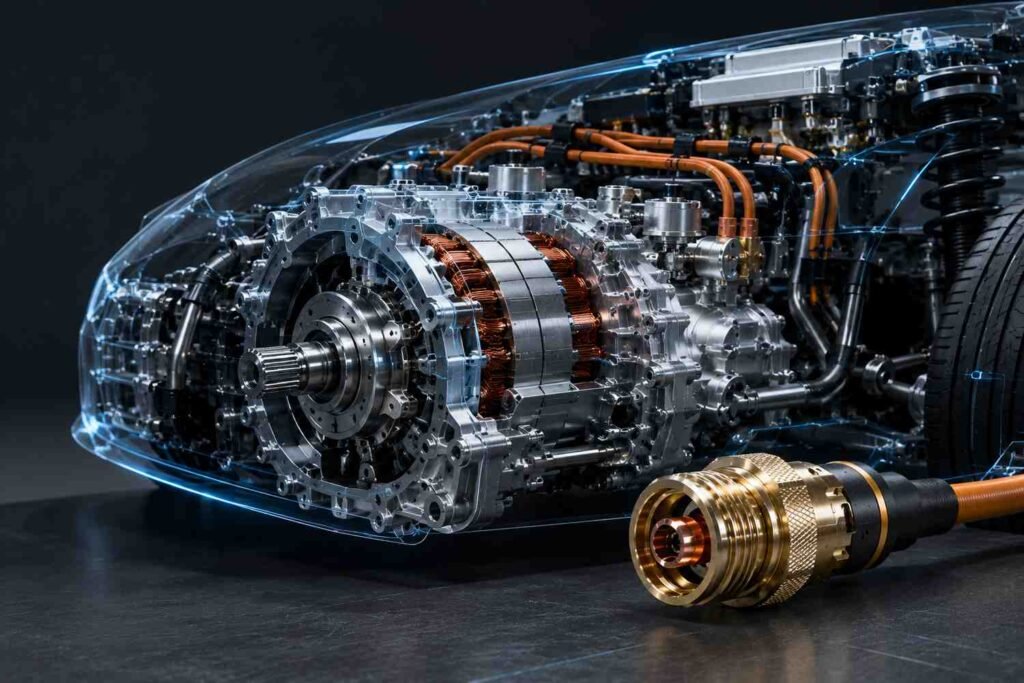
Key takeaway: India’s electric-vehicle manufacturing strategy is increasingly moving beyond vehicle assembly and battery manufacturing toward a broader domestic component ecosystem. Recent government initiatives targeting rare-earth permanent magnets, combined with continued PLI-Auto investment and localisation requirements, indicate that motors, power electronics, charging systems and supporting components will become increasingly important to India’s EV supply chain.
India’s electric-vehicle manufacturing story is entering a more important phase.
The first phase was largely about encouraging EV adoption.
The next phase is about building the supply chain behind those vehicles in India.
That means the conversation is expanding beyond batteries and vehicle assembly.
It now includes motors, power electronics, charging equipment, thermal systems, control units, electrical connections, mechanical components and the specialised materials required to manufacture them.
For OEMs and Tier-1 suppliers, this creates a fundamental sourcing question:
How much of the EV component supply chain can realistically be localised in India?
And for Indian precision metal manufacturers, another question becomes important:
Where can precision component suppliers participate in this expanding EV ecosystem?
What Is EV Component Localisation?
EV component localisation means increasing the manufacturing and sourcing of electric-vehicle components within India’s domestic supply chain rather than relying primarily on imported components.
Localisation can happen at several levels.
A vehicle may be assembled in India, while its major components are manufactured domestically but still depend on imported sub-components.
This creates an important distinction between:
Local assembly
and
Domestic value creation.
The distinction matters because an EV component can be manufactured or assembled in India while still containing imported semiconductors, magnets, specialised materials or other critical inputs.
IEEFA and JMK Research identified this issue in their June 2026 assessment of India’s EV component localisation. Their analysis found that several non-battery EV component categories could potentially reach 90–100% localisation by 2030, but deeper domestic value creation will depend on reducing dependence on imported upstream components and materials.
Why Is India Increasing Focus on EV Component Localisation?
India’s EV market has created a much larger potential manufacturing ecosystem.
But a strong EV industry requires more than vehicle assembly plants.
It requires a network of suppliers capable of producing components consistently and competitively.
Government policy is increasingly focused on that supply chain.
The PLI-Auto programme, for example, was created to strengthen domestic manufacturing of advanced automotive products. As of 31 March 2026, approved applicants had reported ₹44,326 crore of investment, compared with a target of ₹42,500 crore through 31 March 2027.
The programme also requires a minimum 50% Domestic Value Addition for eligible products receiving incentives. As of 16 July 2026, 18 applicants had received DVA certificates covering 154 products or variants.
That creates a direct incentive for companies across the automotive supply chain to develop more domestic manufacturing capability.
What Is India’s New Rare-Earth Magnet Manufacturing Initiative?
One of the clearest signs that EV localisation is moving upstream is India’s programme for manufacturing sintered NdFeB rare-earth permanent magnets.
The Ministry of Heavy Industries issued an RFP in March 2026 for integrated manufacturing facilities with a combined capacity of 6,000 metric tonnes per annum. The scheme has a financial outlay of ₹7,280 crore.
The reason is highly relevant to electric vehicles.
Rare-earth permanent magnets are important in electric motors.
The Government’s July 2026 assessment estimates India’s 2030 REPM requirement at 8,220 MTPA across sectors, of which electric vehicles account for approximately 3,250 MTPA.
The programme is therefore not simply a raw-material initiative.
It is part of a broader attempt to strengthen the domestic EV and advanced-manufacturing supply chain.
Which EV Component Areas Are Being Localised?
The EV supply chain includes much more than batteries.
Important component and system categories include:
| EV area | Examples | Localisation relevance |
|---|---|---|
| Powertrain | Electric motors, motor components | High |
| Power electronics | Inverters, converters and related systems | High |
| Charging | Charging equipment and interfaces | High |
| Thermal systems | Cooling and thermal-management components | High |
| Control systems | Vehicle control units and electronics | High |
| Electrical connections | Connectors, terminals and conductive components | High |
| Structural/mechanical | Mounting and structural components | Established automotive capability |
| Battery systems | Battery packs and related hardware | Major localisation focus |
| Upstream materials | Magnets, semiconductors and specialised materials | Critical localisation challenge |
IEEFA/JMK found that India’s strongest existing localisation has often been in areas that align with established automotive manufacturing capabilities, while EV-specific systems such as motors, power electronics and charging systems still have greater localisation challenges.
This is where supplier development becomes important.
What Does EV Localisation Mean for Precision Metal Component Manufacturers?
EVs are highly electronic, but they are not made entirely from electronic components.
Physical metal components remain necessary throughout many systems and assemblies.
Depending on the engineering application, precision metal components can include:
- Electrical terminals
- Connector components
- Conductive contacts
- Pins
- Bushes
- Inserts
- Precision fasteners
- Mounting components
- Motor-related mechanical components
- Charging-system hardware
- Sensor-related mechanical parts
- Custom machined components
The exact requirement depends on the customer’s engineering design.
That means a precision metal manufacturer does not need to manufacture a complete EV system to participate in the EV supply chain.
A supplier can become part of a much larger system by manufacturing one critical component consistently.
Which Metals Can Be Relevant to EV Components?
Material selection should always be based on the customer’s engineering drawing, specification and application.
However, several metals can have relevant applications.
Brass
Brass can be useful in selected electrical and mechanical applications because of its machinability, corrosion resistance and electrical conductivity.
Potential applications can include certain terminals, connectors, inserts and precision machined components.
Copper
Copper is highly relevant to applications where electrical conductivity is important.
Depending on the design, precision copper components can be used in electrical connections and conductive assemblies.
Aluminium
Aluminium can be attractive where weight reduction is important.
Depending on the engineering requirement, precision aluminium components can support lightweight automotive and electrical applications.
Steel
Steel can provide mechanical strength and durability for various automotive and industrial components.
Stainless Steel
Stainless steel can be appropriate where corrosion resistance and mechanical performance are important.
The correct material should always be determined by the customer’s specification rather than by the material alone.
Why Are OEMs Looking for More Localised Suppliers?
Localisation can provide several potential supply-chain advantages.
Supply continuity
A stronger domestic supplier network can reduce dependence on long international supply chains for selected components.
Lead-time control
Domestic sourcing can potentially simplify logistics and reduce certain transportation lead times.
Engineering collaboration
Closer geographic proximity can make supplier development, sampling and technical communication easier.
Supply-chain resilience
A diversified supplier base can reduce dependence on a single overseas source.
Domestic value addition
Local manufacturing can increase the amount of value created within India’s industrial ecosystem.
However, localisation does not mean OEMs should approve suppliers simply because they are located in India.
Supplier qualification still matters.
What Should OEMs and Tier-1 Suppliers Look for in an EV Component Supplier?
Price is only one part of supplier selection.
For precision components, procurement and engineering teams should evaluate:
- Material capability
Can the supplier manufacture the specified material? - Dimensional capability
Can the required geometry and tolerances be consistently achieved? - Production repeatability
Can the supplier maintain consistency across production batches? - Inspection capability
Can critical dimensions and characteristics be appropriately verified? - Production capacity
Can the supplier support the required volume? - Traceability
Can production and inspection information be traced where required? - Quality systems
Does the supplier operate an appropriate quality-management system? - Delivery performance
Can the supplier meet agreed schedules? - Engineering support
Can the supplier develop components according to drawings or samples? - Scalability
Can the supplier grow with the customer’s programme?
These criteria are particularly important when a component eventually enters an OEM or Tier-1 production environment.
Can Indian Precision Metal Suppliers Support the EV Supply Chain?
Yes, where their manufacturing capabilities match the customer’s component requirements.
The opportunity is not necessarily to become an EV-system manufacturer.
Instead, precision manufacturers can support the EV ecosystem by supplying specific components used within:
- Electric powertrains
- Electrical systems
- Charging equipment
- Control systems
- Automotive assemblies
- Industrial EV infrastructure
The most commercially realistic approach is therefore component-specific supplier development.
An OEM or Tier-1 supplier provides the engineering drawing, material specification, tolerance requirements and expected volume.
The component manufacturer evaluates whether the part can be produced consistently and economically.
That is the point at which a traditional precision-manufacturing capability can connect with the emerging EV supply chain.
How Is Premi Brasscom International Positioned?
Premi Brasscom International has been manufacturing and exporting metal components since 1984.
Its product portfolio includes components manufactured from:
- Brass
- Copper
- Aluminium
- Stainless steel
- Mild steel
The company’s catalogue covers automotive, electrical, electronic, fastener, pneumatic, sanitary, LPG, transformer and other component categories.
Premi Brasscom also holds IATF 16949:2016 and ISO 9001:2015 certifications.
These capabilities are relevant to the broader automotive and electrical component supply chain.
However, Premi Brasscom should not position every existing product as an EV component without validating the actual application.
For an EV-related sourcing requirement, the correct process is:
Customer drawing/sample → material requirement → manufacturing feasibility → inspection requirements → sampling → qualification → production
That gives OEM and Tier-1 buyers a technically credible way to evaluate whether a component can be supplied.
What Questions Should Buyers Ask Before Selecting an EV Component Supplier?
Before approving a precision metal supplier for an EV-related application, procurement and engineering teams should ask:
- Can the supplier manufacture the required material?
- Can it meet the specified dimensions and tolerances?
- Can it maintain repeat-production consistency?
- What inspection equipment and processes are available?
- Can the supplier support the required volume?
- Is traceability maintained?
- Can samples be developed from drawings?
- Can the supplier support PPAP or other customer-specific quality requirements where applicable?
- Can the supplier meet the required delivery schedule?
- Can production scale as the EV programme grows?
These questions help OEMs and Tier-1 suppliers evaluate manufacturing capability rather than simply unit price.
Is EV Localisation Only About Batteries?
No.
This is one of the most important misconceptions in the EV supply chain.
Battery cells and packs are important, but EV localisation also involves:
- Motors
- Power electronics
- Charging systems
- Thermal systems
- Control units
- Electrical connections
- Structural components
- Mechanical components
- Magnets
- Semiconductors
- Specialised materials
IEEFA’s June 2026 analysis specifically identifies motors, power electronics, thermal systems, chargers and control units as important non-battery localisation opportunities.
That means the EV manufacturing opportunity extends across multiple supplier tiers.
What Is the Biggest Challenge for Deeper EV Localisation?
The biggest challenge is not simply assembling more components in India; it is developing the upstream ecosystem needed to create more domestic value.
IEEFA/JMK highlights imported semiconductors, rare-earth magnets and specialised materials as important constraints on deeper value creation.
This is why India’s rare-earth permanent magnet manufacturing initiative matters.
The Government’s scheme aims to create an integrated domestic manufacturing chain from NdPr oxide through finished magnets, with a planned capacity of 6,000 MTPA.
For the automotive supply chain, that is a signal that localisation is gradually moving from final assembly toward upstream component capability.
What Does This Mean for India’s Automotive Supplier Ecosystem?
The next stage of EV localisation will require more than large OEM investments.
It will require supplier networks.
Large systems will depend on Tier-1 suppliers.
Tier-1 suppliers will depend on specialised component manufacturers.
Those component manufacturers will depend on reliable material, machining, inspection and logistics networks.
The resulting ecosystem looks like:
Raw materials
↓
Precision component manufacturers
↓
Specialised Tier-2 suppliers
↓
Tier-1 system suppliers
↓
OEMs
↓
Electric vehicles
This is where Indian precision manufacturing can potentially become part of the localisation story.
Conclusion
India’s EV localisation strategy is moving beyond battery and vehicle assembly toward a broader domestic component ecosystem.
The government’s PLI-Auto programme has already attracted significant investment, while the new rare-earth permanent magnet initiative is targeting a critical upstream input for electric motors.
At the same time, industry research indicates that several non-battery EV component categories could move toward very high localisation levels by 2030 if announced manufacturing capacity is commissioned and supplier ecosystems continue to mature.
For OEMs and Tier-1 suppliers, this creates a need for qualified domestic component partners.
For Indian precision manufacturers, it creates an opportunity to participate in the EV ecosystem through application-specific components rather than attempting to manufacture complete EV systems.
Premi Brasscom International manufactures customised brass, copper, aluminium, stainless-steel and mild-steel components for automotive, electrical, electronic and industrial applications.
For an EV-related component requirement, buyers can share a drawing, sample, material specification or sourcing requirement for manufacturing feasibility evaluation.
Primary source — Ministry of Heavy Industries
The July 2026 PLI-Auto update:
Ministry of Heavy Industries — PLI-Auto July 2026 update
Use this for:
- ₹44,326 crore investment
- PLI-Auto
- ₹25,938 crore scheme
- EV/AAT manufacturing
Primary source — REPM scheme
Ministry of Heavy Industries — Rare Earth Permanent Magnet scheme
Use this for the official scheme/RFP.
Primary source — 2030 REPM demand
Ministry of Heavy Industries — 2030 REPM demand assessment
Use this for:
- 3,250 MTPA EV demand
- 8,220 MTPA total demand
Industry research
IEEFA — Beyond battery packs: Localisation of EV component manufacturing in India
Use this for:
- 90–100% potential localisation
- non-battery components
- localisation gaps
- imported upstream components
RFP
Government of India — Integrated NdFeB REPM manufacturing RFP
Use this if you want to go deeper into the magnet manufacturing programme.
What is EV component localisation in India?
EV component localisation means increasing domestic manufacturing and sourcing of components used in electric vehicles instead of relying primarily on imported components.
Which EV components are being localised in India?
Localisation is progressing across structural and mechanical components, while motors, power electronics, charging systems and other EV-specific systems remain important areas for further domestic development.
Why is rare-earth magnet manufacturing important for EVs?
Rare-earth permanent magnets are important inputs for many electric motors. India is developing domestic manufacturing capacity to reduce import dependence.
Can precision metal suppliers support EV manufacturers?
Yes. Where the supplier’s material, machining, inspection and quality capabilities match the customer’s requirements, precision metal manufacturers can supply components used within larger EV systems.
Are brass and copper components used in EVs?
They can be used in selected electrical, conductive and mechanical applications, depending on the engineering specification.
What should an OEM look for in an EV component supplier?
OEMs should evaluate material capability, dimensional consistency, inspection, production capacity, traceability, quality systems, delivery performance and engineering support.