
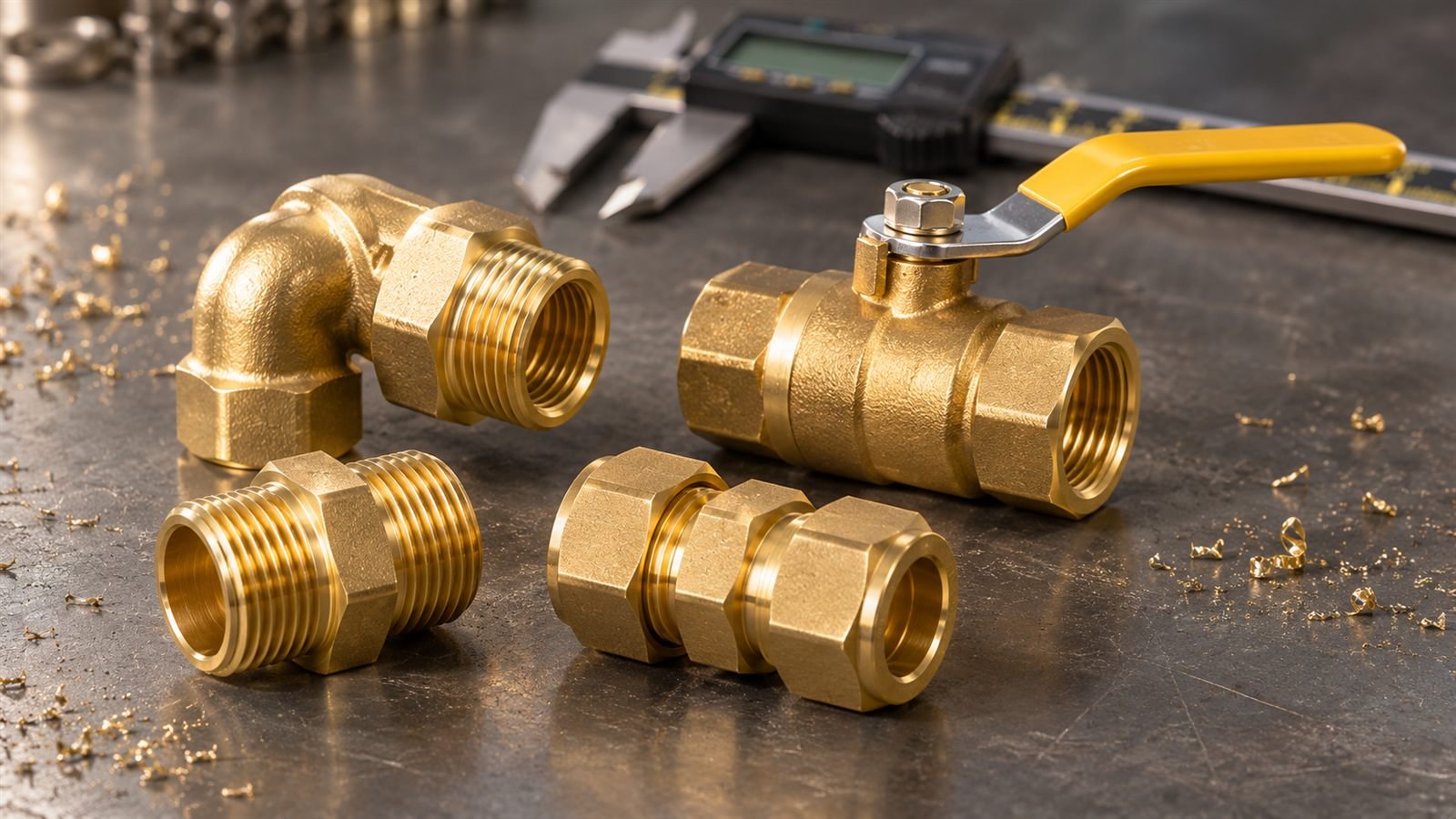
Lead-free brass has moved from a preference to a specification. US and EU rules now attach lead limits to the wetted surfaces of drinking-water fittings, RoHS limits lead in electrical parts, and buyers increasingly apply the same discipline to gas and pneumatic components. A turned part that measures perfectly can still fail on alloy chemistry, so the purchase specification, not the drawing alone, decides whether a shipment is accepted.
This guide sets out what the rules actually require, which alloys replace conventional free-cutting brass, how machining changes, and what to write on the order so the parts you receive are both compliant and economical.
What “lead-free” means in law
Three different rules are in play, and they do not use the same test:
- United States. For drinking-water applications, “lead free” means a weighted average lead content of no more than 0.25% across the wetted surfaces, with solder and flux limited to 0.2%. This has applied since 4 January 2014 under the Reduction of Lead in Drinking Water Act; California’s AB 1953 set the same 0.25% threshold from 2010.
- European Union. The Drinking Water Directive (EU) 2020/2184 sets a lead parametric value of 10 µg/L, tightening to 5 µg/L from 12 January 2036, and requires materials in contact with drinking water to meet hygiene requirements. Compliance is shown by leaching performance, not by alloy percentage alone.
- RoHS. Electrical and electronic equipment is limited to 0.1% lead by weight in any homogeneous material. The old exemption that allowed up to 4% lead in copper alloys has expired for most equipment categories and has been extended for a few, so the current position for your product category has to be checked rather than assumed.
Because one rule measures wetted surface area, one measures homogeneous material and one measures what leaches into water, a component can pass one test and fail another. The order should name which route applies.
Verification: the paperwork that decides acceptance
- A material certificate to EN 10204 3.1 quoting the alloy grade, heat number and lead content.
- Chemical analysis by ICP after digestion. Handheld XRF is useful for screening but reads the surface, so it cannot on its own prove a 0.25% weighted average.
- NSF/ANSI/CAN 61 and NSF/ANSI 372 certification for drinking-water components, or the equivalent national approval for the destination market.
- An IMDS entry and a PPAP or PSW submission wherever the part goes into a vehicle.
- A plating note: nickel or tin over brass improves corrosion resistance and appearance, but it does not make a non-compliant substrate compliant.
Which alloys replace free-cutting brass
Conventional C36000 free-cutting brass contains roughly 3% lead, which acts as an internal lubricant and chip breaker. It machines at a rating of 100, and every replacement is measured against it.
| Alloy | Lead | Where it fits |
|---|---|---|
| CuZn38As (CW511L type) | Under 0.1% | The arsenic addition suppresses dezincification, which makes it the usual choice for potable-water valve bodies and fittings. Covered by EN 12164 and EN 12165. |
| CuZn21Si3P (CW724R type) | None added | Silicon brass. Dezincification-resistant and forgeable, but a narrower machining window and different tool geometry. |
| Bismuth brass (C89833 type) | None added | Machinability close to leaded brass, but bismuth melts at about 271 °C, so it smears at the cutting edge and causes hot shortness in hot forming. |
| Low-lead CuZn40 / CuZn42 | Roughly 0.1-0.4% by grade | A cheaper route where the rule allows it. Check dezincification resistance and strength before substituting. |
In practice, lead-free grades machine at roughly 70-90% of the rate of C36000, so cycle time and tooling should be planned before a price is quoted, not after.
Machining consequences to budget for
- Chips. Without lead the chip does not break as readily, and stringy chips wrap the tool and spoil the finish. Tool geometry with a sharper positive rake and a chip breaker designed for the alloy matters more than any coating.
- Heat and wear. Cutting forces and temperatures rise, so adhesive wear and built-up edge appear sooner. Polished flutes, higher cutting speed with reduced feed, and high-pressure coolant usually recover part of the lost productivity.
- Tolerances. Diameters in the ±0.02-0.05 mm band and finishes around Ra 1.6 µm stay achievable, but they depend on stable tool life, so tool-change intervals shorten.
- Threads. Lead-free alloys work-harden slightly more, and thread rolling often gives a better result than single-point threading on small gas and pneumatic bodies.
- Scrap. Longer chips and thinner walls raise material loss, which belongs in the piece price.
Dezincification and stress corrosion: the two failure modes buyers forget
High-zinc brasses can lose zinc in soft or heavily chlorinated water, leaving a porous copper sponge that eventually leaks. Specify a dezincification requirement together with the test method and the acceptance depth. ISO 6509-1 is the usual reference for copper alloys, and the result should appear on the material certificate.
Machined and cold-formed brass also carries residual stress, and in ammonia or ammonium-bearing environments that stress drives season cracking. A stress-relief anneal in the 250-350 °C range removes most of it, and gas fittings or parts shipped through humid routes should specify it explicitly.
What to put in the purchase specification
- Alloy grade and product standard, with the maximum lead content stated as a number.
- The compliance route: 0.25% weighted average, RoHS 0.1%, NSF 372 or a leaching test, named explicitly.
- Dezincification test standard and maximum penetration depth.
- Temper and mechanical properties, for example R330 or R360 under EN 12164.
- Dimensional tolerances, surface finish, and the thread standard: ISO 7 or EN 10226 for taper threads, ISO 228 for parallel.
- Pressure and leak test: medium, pressure, duration and acceptance criterion.
- Residual stress relief, where the part is cold worked or heavily machined.
- Surface treatment and its thickness, plus any salt-spray requirement.
- Documentation: 3.1 certificate, PPAP level, IMDS entry, first-article report.
- Marking, packaging and export paperwork.
Gas, water and pneumatic parts are not the same problem
- Gas. Brass ball valves and fittings are commonly specified to EN 331, with elastomer seals to EN 549 and tightness tested at working pressure. Residual stress relief matters because a cracked body is a safety failure, not a warranty claim.
- Water. The whole specification turns on dezincification resistance and lead leaching. Grain structure and copper content matter as much as the alloy name.
- Pneumatic. Pressure cycling, wall thickness at the thread root and thread galling drive the design, and dry oil-free air changes the corrosion picture compared with wet systems.
- Electrical. The RoHS position on the exact grade and the plating choice dominate. Confirm the exemption status before a grade is fixed on a production drawing.
Cost and timing: treat it as a re-validation
Material price for lead-free grades commonly sits 5-15% above C36000, and the machining penalty adds another 10-25% to cycle time. Tool trials, first-article inspection and customer approval typically add three to six weeks before volume supply. That is a normal cost of compliance, and it is far cheaper when it is designed into a drawing revision than when it is discovered at incoming inspection.
Re-specifying an existing part
Premi Brasscom International has been turning brass, copper, aluminium, stainless steel and mild steel components since 1984. The company is ISO 9001:2015 and IATF 16949 certified and supplies more than 550 standard products and 300 custom components from its plant at Plot No. 3056, G.I.D.C. Phase III, Dared, Jamnagar 361 004, Gujarat, India.
If you are moving a fitting, valve body or terminal to a lead-free alloy, send the drawing, the annual volume and the compliance route that applies to your market to info@premibrass.com, or use the enquiry form. Related product ranges: LPG parts, pneumatic parts, sanitary parts, electrical parts and automotive brass components.