
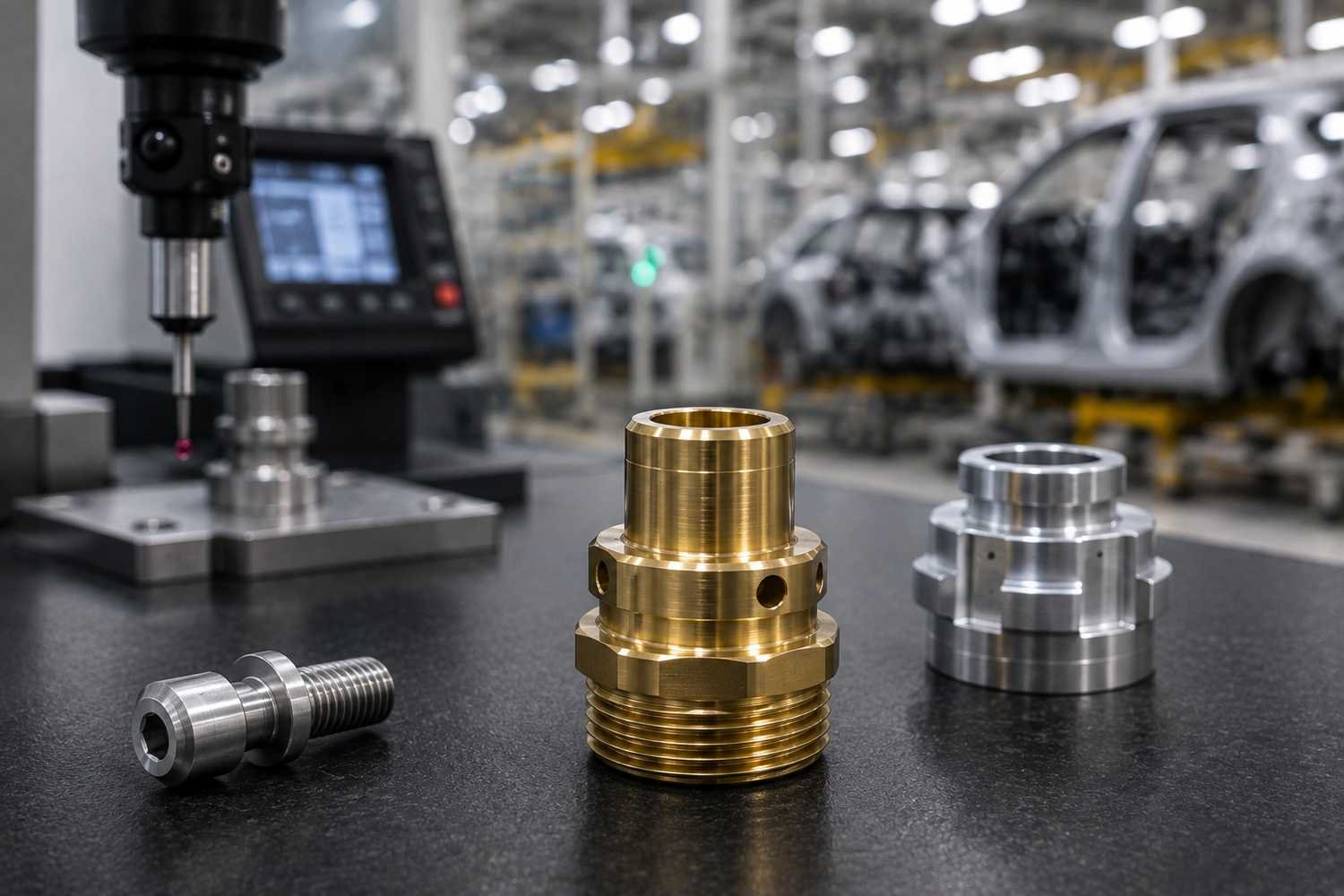
Why US Buyers Are Looking to India for Auto Components in 2026
Key takeaway: India is becoming an increasingly relevant sourcing option for US automotive buyers looking to diversify supply chains. Indian auto-component exports reached approximately $24 billion in FY2025–26, while industry sources report that Indian suppliers are receiving RFQs from US companies seeking to reduce China dependence. For buyers, the opportunity is real—but Indian suppliers must demonstrate quality, traceability, capacity, delivery reliability and supply-chain transparency.
Global automotive sourcing is changing.
For many years, automotive buyers built supply chains around cost, scale and established supplier relationships.
Today, procurement teams are adding another question:
How dependent is this supply chain on a single country?
That question is becoming increasingly important for automotive manufacturers and Tier-1 suppliers.
India is emerging as one of the countries being considered for supply-chain diversification.
The opportunity is particularly relevant to auto components.
India’s auto-component exports reached approximately $24 billion in FY2025–26, with the United States remaining the country’s largest auto-parts export market at around 26% of shipments.
More importantly, Indian suppliers are reportedly receiving requests for quotations from US companies seeking to reduce dependence on China. Some of these RFQs are asking suppliers to demonstrate that their supply chains are not dependent on China.
For Indian component manufacturers, that changes the conversation.
The opportunity is no longer simply:
“Can India manufacture this component at a competitive price?”
The question is becoming:
“Can India provide a reliable, qualified and transparent alternative supply source?”
Why Are US Buyers Considering India for Auto Components?
US buyers are considering India because global automotive supply chains are increasingly focused on diversification, resilience and reducing excessive dependence on individual sourcing countries.
India already has an established automotive manufacturing ecosystem.
According to ACMA, the Indian auto-component industry recorded approximately ₹7.59 lakh crore ($85.9 billion) in revenue in FY2025–26, representing 12.7% growth in rupee terms.
The industry also has an established export base.
ACMA reports that Indian auto-component exports were approximately $22.9 billion in FY2025, with major export categories including drive transmission and steering systems, engine components, suspension and braking systems, and body and chassis products.
This means US buyers are not starting with an unknown manufacturing ecosystem.
India already supplies components to international markets.
The next opportunity is to expand the number of qualified suppliers participating in global automotive programmes.
What Is China+1 Sourcing?
China+1 sourcing means maintaining or developing supply outside China so that a company is not excessively dependent on a single manufacturing country.
It does not necessarily mean completely replacing China.
A buyer may instead build a second qualified source in another country.
For example:
Existing China supplier
Qualified India supplier
=
More diversified supply chain
This approach can provide additional flexibility when companies face:
- Tariff changes
- Geopolitical disruption
- Logistics problems
- Capacity constraints
- Supplier shutdowns
- Raw-material risks
- Unexpected demand changes
BCG’s 2026 analysis of the “factory of the future” identifies India and other South and Southeast Asian economies as emerging alternatives to China in sectors including vehicle components, while also warning that future competitiveness will increasingly depend on automation and manufacturing productivity.
That distinction matters.
India cannot rely on being a lower-cost manufacturing destination alone.
What Does the Current US RFQ Trend Tell Suppliers?
The reported increase in US RFQs asking Indian suppliers about China dependence shows that supply-chain transparency is becoming part of supplier qualification.
According to reporting on India’s auto-component exports, some US RFQs explicitly ask Indian suppliers to confirm that their supply chains are not dependent on China.
That is a significant change in procurement behaviour.
Historically, a buyer might ask:
- What is your piece price?
- What is your annual capacity?
- What is your lead time?
- What quality certifications do you have?
A more risk-focused buyer may now also ask:
- Where do your raw materials come from?
- Which processes are outsourced?
- Which sub-components are imported?
- Do you have alternative sources?
- What percentage of the component’s value comes from overseas?
- Can you document your supply chain?
- What happens if a key supplier becomes unavailable?
For Indian suppliers targeting global buyers, these questions cannot be treated as secondary.
Does Being an Indian Manufacturer Automatically Mean a Component Is China-Free?
No.
This is an important distinction.
A component manufactured in India can still contain imported raw materials, sub-components or externally sourced inputs.
Therefore:
Made in India ≠ automatically China-independent
A serious buyer may evaluate the complete supply chain rather than only the final manufacturing location.
For suppliers, this means procurement teams should be able to understand:
- Material source
- Subcontracted processes
- Purchased components
- Plating or finishing sources
- Packaging sources
- Critical raw materials
- Alternative suppliers
The exact disclosure requirements will depend on the customer’s programme and contractual requirements.
Why Is Supply-Chain Transparency Becoming a Competitive Advantage?
Supply-chain transparency allows buyers to understand and manage sourcing risk before a disruption occurs.
Imagine two suppliers offering an identical component.
Supplier A
Offers the lowest unit price but has multiple undisclosed overseas dependencies.
Supplier B
Has a slightly higher unit price but provides:
- Clear material sourcing
- Documented suppliers
- Traceability
- Alternative sources
- Defined quality controls
- Production records
- Transparent manufacturing processes
A procurement team evaluating long-term supply risk may prefer Supplier B.
This is why global sourcing is increasingly moving from:
Lowest price
toward:
Total landed cost + quality + resilience + transparency
What Makes India Attractive for Automotive Component Sourcing?
India has several structural advantages.
Established automotive manufacturing ecosystem
India has a large domestic automotive market and a significant component supplier base.
Existing export capability
Indian component manufacturers already supply international markets. ACMA reports substantial exports across multiple component categories.
Engineering capability
India has developed a broad engineering and manufacturing ecosystem supporting automotive production.
Growing global integration
Indian component manufacturers are increasingly connected to international OEM and Tier-1 supply chains.
Diversification potential
For buyers seeking alternatives to concentrated China sourcing, India can provide another qualified manufacturing location.
But these advantages do not automatically qualify an individual supplier.
The supplier still has to pass the buyer’s technical and commercial evaluation.
What Should a US Buyer Check Before Sourcing Auto Components From India?
A US buyer should evaluate an Indian supplier across technical capability, quality, capacity, traceability, supply-chain transparency and total cost—not simply piece price.
A practical evaluation can look like this:
| Evaluation area | Buyer question |
|---|---|
| Manufacturing | Can the supplier manufacture the component consistently? |
| Material | Can the specified material and grade be supplied? |
| Tolerance | Can drawing requirements be maintained? |
| Quality | What quality system and controls are in place? |
| Inspection | How are critical dimensions verified? |
| Capacity | Can annual demand be supported? |
| Traceability | Can production and inspection records be traced? |
| Supply chain | Where are materials and critical inputs sourced? |
| Outsourcing | Which processes are subcontracted? |
| Delivery | Can agreed lead times be maintained? |
| Development | Can samples be developed and qualified? |
| Commercial | What is the total landed cost? |
This is the difference between finding a manufacturer and finding a qualified supplier.
Why Are Precision Metal Components Relevant to This Sourcing Shift?
Precision metal components are often suitable candidates for supplier diversification because they can be specified clearly through engineering drawings, material grades, dimensional tolerances and inspection requirements.
Depending on the application, automotive assemblies can include:
- Brass components
- Copper components
- Aluminium components
- Steel components
- Stainless-steel components
- Precision turned parts
- Inserts
- Bushings
- Shafts
- Fasteners
- Terminals
- Connectors
- Mounting components
- Custom machined parts
The exact component and manufacturing process depend on the customer’s design.
A supplier should therefore evaluate each drawing individually rather than making broad claims about every automotive component.
Why Are Brass Components Relevant to Automotive Sourcing?
Brass can be relevant to selected automotive electrical and mechanical applications where its material properties meet the engineering specification.
Depending on the design, brass may be considered for:
- Terminals
- Connectors
- Inserts
- Electrical fittings
- Precision-machined components
The material grade, dimensional requirements, surface treatment and application should always be confirmed from the customer’s drawing and specification.
Why Are Copper Components Relevant?
Copper can be relevant where electrical conductivity is a critical requirement.
Potential automotive applications can include selected:
- Conductive components
- Electrical connection parts
- Terminals
- Power-related components
Again, the actual suitability depends on the customer’s engineering requirements.
Where Does Aluminium Fit Into Automotive Sourcing?
Aluminium can be attractive for applications where low weight and other specified mechanical or thermal properties are important.
Potential applications can include:
- Housings
- Mounting components
- Structural parts
- Thermal-management components
- Precision-machined components
The final material choice should be based on the customer’s engineering specification rather than a generic material preference.
How Important Is Quality for China+1 Automotive Sourcing?
Quality is critical because a second source is only useful if it can reliably meet the same technical requirements as the incumbent supplier.
A buyer does not reduce supply-chain risk by moving a component to a supplier that creates quality risk.
A proper qualification process can therefore include:
- Supplier prequalification
- Drawing review
- Material verification
- Sample development
- Dimensional inspection
- Functional validation where applicable
- Process evaluation
- Production trial
- Approval
- Serial production monitoring
The exact process depends on the customer’s quality system and programme requirements.
Why Is Traceability Important?
Traceability allows the buyer and supplier to identify what was produced, when it was produced, with which material and under which production conditions.
For automotive applications, traceability can become particularly important when:
- A component is safety-related
- A customer requires batch records
- Material certification is required
- A non-conformance investigation occurs
- Production lots need to be identified
- Corrective action is required
Traceability is therefore not just paperwork.
It is part of supply-chain control.
What Should Suppliers Know About US Automotive Buyers?
A supplier targeting the US market should understand that the buyer may evaluate the company at several levels.
Commercial
Can the supplier offer competitive total cost?
Technical
Can the supplier manufacture the component according to the drawing?
Quality
Can the supplier consistently meet requirements?
Capacity
Can the supplier support programme volumes?
Supply chain
Can the supplier demonstrate where critical inputs originate?
Delivery
Can the supplier meet the customer’s required schedule?
Risk
Can the supplier continue production if one supplier or logistics route is disrupted?
The supplier’s sales presentation should therefore be more than a product catalogue.
It should communicate manufacturing confidence.
How Should an Indian Supplier Respond to a US RFQ?
An Indian supplier should respond to a US RFQ with technical and supply-chain evidence, not only a price quotation.
A strong RFQ response can include:
- Drawing review
- Material confirmation
- Manufacturing feasibility
- Estimated cycle/process route
- Quality approach
- Inspection method
- Sample timeline
- Production capacity
- Lead time
- Packaging approach
- Supply-chain information where requested
- Commercial quotation
This gives the buyer enough information to evaluate the supplier properly.
What Is Total Landed Cost?
Total landed cost is the complete cost of getting the component from the supplier to the buyer’s required destination.
It can include:
Component price
Packaging
Freight
Insurance
Import duties/tariffs
Customs and other applicable charges
=
Landed cost
A supplier with a lower factory price is not necessarily the lowest-cost source after logistics and trade costs are considered.
This is why procurement teams should compare suppliers using a common landed-cost model.
Are US Tariffs Still a Risk for Indian Auto Component Suppliers?
Trade policy remains a risk, but auto parts have received specific treatment under the current US measures.
The Indian government stated that products already covered under Section 232 measures, including steel, aluminium and auto parts, are not subject to the additional 10% duty referenced in its August 2026 clarification. The government also said around 45% of India’s US exports remain outside that additional duty’s scope.
However, exporters should not assume that every automotive product has identical tariff treatment.
The applicable tariff classification and trade measures must be verified for the specific product and shipment.
Trade policy can also change.
For this reason, exporters should treat tariff analysis as part of the commercial quotation process.
Is India Becoming a Stronger Alternative to China for Auto Components?
India is becoming a more relevant diversification option, but it is not a universal replacement for China.
That distinction matters.
China continues to have major advantages in:
- Scale
- Supply-chain depth
- Manufacturing infrastructure
- Raw-material ecosystems
- Automation
- Supplier density
BCG’s 2026 research makes a similar point: India and other South and Southeast Asian countries are emerging as alternatives in selected manufacturing sectors, but the next phase of competitiveness will require investment in automation, productivity and manufacturing technology.
Therefore, the strongest positioning for an Indian supplier is not:
“India can replace China for everything.”
It is:
“India can provide a qualified alternative source for specific components where technical, quality, commercial and supply-chain requirements can be met.”
That is much more credible.
What Does This Mean for OEM and Tier-1 Procurement?
For OEM and Tier-1 procurement teams, the opportunity is to identify components where a second qualified source could improve resilience.
A practical starting point is to review components that:
- Have stable annual demand
- Are currently sourced from a concentrated supplier base
- Have clear engineering specifications
- Can be produced using established manufacturing processes
- Have measurable quality characteristics
- Have enough volume to justify supplier development
- Can be qualified without excessive programme risk
The goal should be strategic dual sourcing, not simply supplier switching.
Example: A US Buyer Evaluating an Indian Precision Component Supplier
Consider a hypothetical US Tier-1 supplier currently sourcing a precision-machined brass component from one overseas source.
The procurement team could evaluate an Indian supplier using:
| Requirement | What to verify |
|---|---|
| Drawing | Current approved revision |
| Material | Specified brass grade |
| Dimensions | Critical tolerances |
| Inspection | Measurement method |
| Annual volume | Programme requirement |
| Capacity | Supplier production capability |
| Quality | Customer-specific requirements |
| Traceability | Required batch records |
| Supply chain | Material and critical input sources |
| Outsourcing | Plating/finishing/subcontracted processes |
| Sample | Qualification process |
| Lead time | Production + shipping |
| Cost | Total landed cost |
| Risk | Backup supply and continuity |
This example is illustrative and does not represent a Premi Brasscom customer programme. Actual sourcing decisions must be based on the buyer’s engineering, quality and commercial requirements.
What Is the Opportunity for Premi Brasscom International?
Premi Brasscom International operates in the precision metal component space across brass, copper, aluminium, steel and stainless-steel components, with applications including automotive, electrical, electronic and industrial requirements.
That makes the broader China+1 and India-sourcing trend commercially relevant to the company.
But the correct positioning is not:
“We can replace Chinese suppliers.”
The stronger positioning is:
“We can evaluate specific customer drawings and manufacturing requirements to determine whether the component is suitable for Indian precision manufacturing.”
The commercial process should remain:
Drawing / sample
↓
Material and manufacturing feasibility
↓
Sample development
↓
Inspection / qualification
↓
Production
↓
Repeat supply
For international buyers, the value proposition should be based on:
Quality + consistency + capacity + transparency + delivery + competitive total cost.
What Should US Buyers Do Before Moving a Component to India?
Before transferring a component, procurement teams should:
- Identify the exact component and approved drawing.
- Review current supplier performance.
- Determine the required annual volume.
- Identify critical dimensions and quality characteristics.
- Review the Indian supplier’s manufacturing capability.
- Review material and supply-chain sourcing.
- Request samples.
- Complete the required qualification process.
- Compare total landed cost.
- Approve the supplier only after technical and commercial requirements are satisfied.
This creates a controlled supplier-development process rather than an immediate supplier switch.
Frequently Asked Questions
Why are US companies looking to India for auto components?
US companies are increasingly considering India as a diversification source for automotive components, including companies seeking to reduce dependence on China. Indian suppliers have reportedly received RFQs that specifically address China dependence.
Is India becoming an alternative to China for automotive sourcing?
India is becoming a more relevant alternative for selected automotive components, but it should be viewed as a diversification option rather than a universal replacement for China.
How large are India’s auto-component exports?
Indian auto-component exports reached approximately $24 billion in FY2025–26 according to reporting based on industry data, while ACMA’s FY2025 data shows $22.9 billion in exports.
Why is supply-chain transparency important for US buyers?
Transparency helps buyers understand material sources, subcontracted processes and other dependencies that could affect supply continuity.
Can Indian suppliers provide China-independent components?
Some Indian suppliers may be able to provide products with limited or no China dependence, but this must be established through the supplier’s actual material, component and subcontracting supply chain. Manufacturing location alone is not sufficient evidence.
What precision components can US buyers source from India?
Potential categories include selected brass, copper, aluminium, steel and stainless-steel precision components, turned parts, inserts, terminals, fasteners, bushings and other engineered components, depending on the customer’s design.
What should a US OEM check before approving an Indian component supplier?
The buyer should evaluate technical capability, quality, inspection, capacity, traceability, supply-chain transparency, delivery performance and total landed cost.
Are automotive components affected by current US tariff measures?
Current US trade measures treat different product categories differently. India’s government stated that auto parts covered by Section 232 measures are not subject to the additional 10% duty described in its August 2026 clarification. Product-specific tariff treatment should still be verified before quoting.
Is the lowest-priced Indian supplier necessarily the best China+1 supplier?
No. The better supplier is the one that meets the buyer’s technical, quality, capacity, delivery, transparency and total-cost requirements.
How can a US buyer start sourcing a precision component from India?
A practical first step is to provide the supplier with the component drawing or sample, material specification, annual volume and quality requirements so manufacturing feasibility and commercial viability can be evaluated.
Conclusion
The China+1 strategy is becoming more specific.
For automotive procurement teams, it is increasingly about identifying which individual components can be sourced from qualified alternatives without creating new quality or supply risks.
India is well positioned to participate in that shift because it already has a large automotive manufacturing ecosystem and an established export base. Indian auto-component exports reached approximately $24 billion in FY2025–26, while the United States remained the largest export market.
The more interesting signal, however, is the reported increase in US RFQs asking Indian suppliers to demonstrate reduced China dependence.
That changes the supplier conversation.
Global buyers are not simply looking for:
Low cost.
They are looking for:
Qualified manufacturing + consistent quality + transparent supply chains + reliable delivery + competitive total cost.
For Indian precision component manufacturers, that creates a genuine opportunity.
But the opportunity must be earned component by component through engineering feasibility, qualification and dependable production.
Premi Brasscom International manufactures precision metal components in brass, copper, aluminium, steel and stainless steel for automotive, electrical, electronic and industrial applications.
International buyers can share a component drawing, sample, material specification or sourcing requirement for manufacturing-feasibility evaluation.