
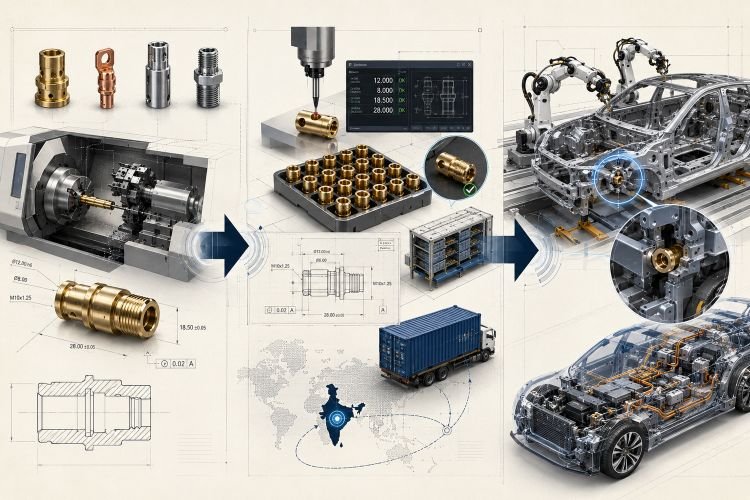
India’s automotive industry is entering a new phase of expansion.
The country’s auto-component industry recorded approximately ₹7.6 lakh crore (US$85.9 billion) in turnover during FY2025–26, registering 12.7% year-on-year growth.
But there is another number that deserves the attention of automotive procurement teams.
India’s auto-component imports reached approximately US$25.4 billion, while exports were around US$24 billion, creating a component trade deficit of approximately US$1.37 billion.
For OEMs and Tier-1 suppliers, this raises an important question:
Can India strengthen its domestic automotive component supply chain while continuing to increase vehicle production and exports?
The answer increasingly depends on capable local suppliers.
Why Automotive Component Localisation Matters
Automotive localisation is not simply about replacing an imported component with an Indian-made component.
It is about developing a reliable domestic supply chain capable of delivering the required:
- Quality
- Precision
- Material consistency
- Production volume
- Cost competitiveness
- Delivery performance
- Technical support
As vehicle production increases, OEMs and Tier-1 suppliers need a larger and more dependable supplier base.
This is particularly important for smaller precision components that are used throughout automotive assemblies.
India’s Automotive Component Industry Is Growing
India’s automotive component industry grew strongly during FY2025–26, with turnover reaching approximately ₹7.6 lakh crore.
OEM supplies increased significantly, while exports also reached approximately US$24 billion.
This growth reflects India’s expanding role in the global automotive manufacturing ecosystem.
Government policy is supporting this direction as well.
The Production Linked Incentive scheme for automobiles and auto components is designed to encourage advanced automotive manufacturing and greater domestic value addition.
As investment in automotive manufacturing increases, opportunities also expand for Indian manufacturers supplying components to OEMs and Tier-1 companies.
The Import Gap Creates an Opportunity for Indian Suppliers
The industry’s growth has also exposed an important challenge.
India continues to import a significant volume of automotive components.
According to industry data, imports reached approximately US$25.4 billion in FY2025–26, exceeding exports of approximately US$24 billion.
This does not mean that every imported component can or should be manufactured domestically.
Some advanced components require specialised technologies, materials or manufacturing capabilities that may not yet be available at sufficient scale in India.
However, it does highlight an opportunity:
Indian component manufacturers with strong engineering, quality and production capabilities can become increasingly important to the domestic supply chain.
Why Precision Metal Components Matter
A modern vehicle contains thousands of individual components.
Many of these components are small, but their dimensional accuracy and consistency can directly affect the performance of larger assemblies.
Examples include:
- Precision turned components
- Bushes
- Pins
- Inserts
- Threaded components
- Fasteners
- Electrical terminals
- Connectors
- Brass components
- Copper components
- Aluminium components
- Stainless-steel components
- Custom machined parts
For these components, manufacturing consistency is critical.
A supplier may successfully manufacture a prototype or sample, but automotive production requires the ability to reproduce the same component repeatedly and reliably.
What OEMs and Tier-1 Suppliers Should Look for in a Local Supplier
Localisation only works when the domestic supplier can meet the technical and commercial expectations of the customer.
1. Manufacturing Capability
The supplier should have appropriate machinery and processes for the required component geometry, dimensions, tolerances and production volume.
2. Material Capability
Different automotive applications require different materials.
Brass, copper, aluminium, stainless steel and mild steel can all serve different engineering requirements.
A supplier capable of manufacturing across multiple materials can provide greater sourcing flexibility.
3. Dimensional Consistency
Precision components must be manufactured consistently.
Even small dimensional variations can create problems during assembly or downstream operations.
4. Quality Systems
Automotive customers require disciplined quality processes.
Inspection, process control, documentation and traceability become particularly important as production volumes increase.
5. Production Capacity
A supplier must be able to move from sample production to repeatable mass production.
OEM and Tier-1 sourcing teams therefore need to evaluate not only current production capability but also the supplier’s ability to support future volume requirements.
6. Delivery Reliability
A component that arrives late can disrupt an entire production schedule.
Reliable delivery therefore needs to be evaluated alongside quality and price.
The Role of Brass, Copper and Aluminium Components
Material selection is becoming increasingly important as automotive architectures evolve.
Brass
Brass offers useful characteristics including machinability, corrosion resistance and electrical conductivity.
It can be used in various automotive, electrical and industrial applications.
Copper
Copper is particularly important where electrical conductivity is required.
This makes copper components relevant to electrical systems and the broader vehicle electrification ecosystem.
Aluminium
Aluminium provides a combination of low density, machinability and useful mechanical properties.
It can be suitable for applications where weight reduction is an important consideration.
The appropriate material should always be selected according to the component’s engineering requirements and application.
EVs Are Creating New Component Opportunities
Vehicle electrification is also changing the automotive component supply chain.
Electric vehicles rely heavily on electrical and electronic systems.
This increases the importance of components such as:
- Electrical terminals
- Connectors
- Conductive components
- Inserts
- Precision fasteners
- Motor-related components
- Charging-system components
- Electronic assembly components
For Indian precision metal manufacturers, this creates opportunities beyond traditional internal-combustion-engine components.
Suppliers that can support both conventional automotive applications and emerging electrical/electronic requirements can potentially serve a wider customer base.
Localisation Does Not Mean Compromising on Quality
One of the biggest misconceptions about localisation is that domestic sourcing is primarily about reducing cost.
Cost is certainly important.
But automotive procurement is ultimately concerned with total supply-chain value.
A component supplier needs to provide the right combination of:
Quality + Precision + Cost + Capacity + Delivery + Technical Capability
If a locally manufactured component has inconsistent quality or unreliable delivery, simply manufacturing it domestically does not create a better supply chain.
Successful localisation therefore requires capable suppliers.
Why Indian Precision Component Manufacturers Have an Opportunity
India already has a large engineering and manufacturing ecosystem.
As automotive production expands, domestic component manufacturers can potentially become important partners for OEMs and Tier-1 suppliers.
This is particularly relevant for manufacturers capable of producing customised components according to:
- Engineering drawings
- Customer specifications
- Material requirements
- Dimensional tolerances
- Application requirements
- Production-volume requirements
The opportunity is not limited to large visible automotive components.
The supply chain also depends on thousands of smaller precision-engineered parts.
Premi Brasscom International and Automotive Components
Premi Brasscom International has been manufacturing and exporting metal components since 1984.
The company manufactures components using materials including:
- Brass
- Copper
- Aluminium
- Stainless steel
- Mild steel
Its product portfolio includes automotive components, electrical components, electronic components, fasteners, pneumatic components, sanitary components, LPG-related components, transformer components and other customised metal parts.
The company is certified to IATF 16949:2016 and ISO 9001:2015, supporting its positioning for quality-conscious automotive and industrial applications.
For OEMs, Tier-1 suppliers and industrial buyers looking for an Indian precision metal component manufacturer, the ability to work across multiple materials and component categories can provide greater sourcing flexibility.
What Automotive Procurement Teams Should Do Next
For companies evaluating automotive component manufacturers in India, the supplier selection process should go beyond comparing unit prices.
Before approving a supplier, procurement and engineering teams should evaluate:
Manufacturing capability
Material capability
Quality systems
Inspection capability
Production capacity
Repeatability
Traceability
Delivery performance
Engineering support
Long-term scalability
A supplier that can meet these requirements can become more than a vendor.
It can become part of the OEM or Tier-1 supplier’s long-term manufacturing ecosystem.
Conclusion
India’s automotive component industry is growing rapidly, but the industry’s import dependence shows that there is still significant room for domestic supply-chain development.
For OEMs and Tier-1 suppliers, this creates an opportunity to develop stronger relationships with capable Indian component manufacturers.
For precision metal component manufacturers, it creates an opportunity to move beyond price-based competition and demonstrate capabilities in quality, engineering, consistency, capacity and delivery.
As India’s automotive industry continues to expand, localisation will increasingly depend on the strength of the suppliers behind the vehicle.
For automotive, electrical and industrial applications requiring precision brass, copper, aluminium, stainless-steel or mild-steel components, Premi Brasscom International can support customised manufacturing requirements.
Have an automotive component drawing, sample or sourcing requirement? Contact Premi Brasscom International to discuss your requirement.