
Two suppliers quote the same brass fitting drawing and the numbers land 40% apart. Neither is necessarily wrong. Brass CNC machining cost is built from a stack of variables — alloy, bar yield, cycle time, tolerance band, finishing, batch size and documentation — and each supplier weighs that stack differently. Buyers who understand the stack can read a quote instead of guessing at it, and can usually move the price 10–20% without touching the drawing.
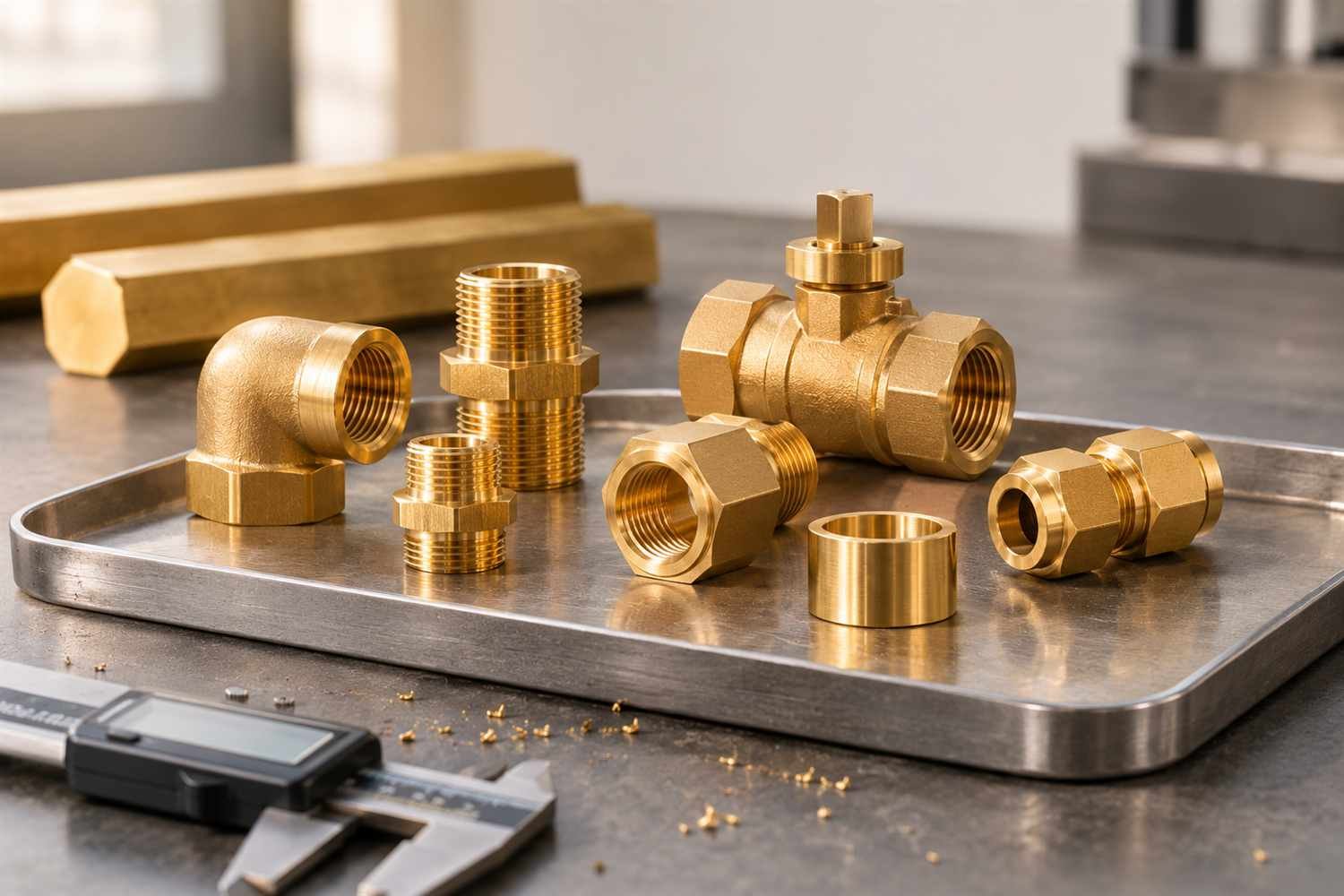
Why two quotes for the same brass part can differ by 40%
Most of the gap sits in five places. A supplier running a cam-fed multi-spindle machine on 50,000 pieces is quoting a different process from a shop running a CNC lathe on 2,000 pieces. Add a different alloy form, a tighter inspection regime and a different Incoterm, and a 40% spread is normal rather than suspicious.
- Alloy grade and whether the mill supplies solid rod, hollow rod or forgings
- How much of each bar becomes a chip rather than a part
- Machine type and cycle time per piece
- Tolerance band and the amount of inspection attached to it
- Volume, plating, documentation and freight terms
1. Alloy grade: the mill price behind every brass quote
Roughly 35–50% of the price of a machined brass component is the metal itself, so the alloy decision sets the floor of the quote. Brass rod is priced as copper plus alloying elements plus a mill conversion premium, so the quote tracks the copper market with a lag of a few weeks.
Free-cutting brass such as C36000 machines at high speeds with short, broken chips, which keeps cycle time and tool wear low. Forging brass such as C37700 or C35300 machines more slowly but takes hot forming and higher strength. Lead-free grades cost more at the mill and often machine slower, so a lead-free switch can add cost even when the drawing looks unchanged. Our lead-free brass specification guide covers where that trade-off is worth paying, and the alloy selection guide compares brass, copper and aluminium on cost and machinability.
2. Bar diameter, cut-off and material yield
Material is bought by weight and sold inside the part. The difference is yield, and yield is where quiet cost hides.
- Nearest standard bar size. A part that fits a 12 mm rod costs less than the same part turned down from 16 mm, because the removed ring becomes chips.
- Cut-off and remnant. Bar-end loss and saw kerf are small per piece and large per batch.
- Hollow rod. For a through-bored part, hollow rod can cut both material weight and drilling time.
- Scrap credit. Brass chips have real value, and a supplier who credits swarf back is quoting honestly.
Ask for the bar size assumed in the quote. If it is two sizes above what the drawing needs, the price is carrying metal you never receive.
3. Cycle time: machine type, axis count and tooling
Machining is typically 25–40% of the piece price, and cycle time is the lever inside it.
- Swiss-type lathes suit long, slender parts and small diameters, holding concentricity in one pass.
- Fixed-head CNC lathes with live tooling cross-mill, drill and slot without a second operation — often the cheapest route for a part with a cross-hole.
- Cam or multi-spindle machines win on very high volume, where the setup is amortised across hundreds of thousands of pieces.
- Second operations — milling flats, tapping off-axis holes, broaching — add handling, queue time and a second chance for a dimension to drift.
Design choices that remove an operation usually beat any negotiation on hourly rate. Our CNC turning design review checklist lists the features that most often force a second op.
4. Tolerances and inspection level
A ±0.05 mm band runs at a comfortable feed and speed. A ±0.01 mm band forces slower passes, more frequent in-process checks and sometimes a temperature-controlled room. Inspection adds cost in proportion to how much of the batch is measured and how it is measured: vernier and plug gauges, air gauging, or CMM with a printed report.
Specify tolerance only where the function needs it. A cosmetic dimension held to a functional tolerance is one of the most common sources of avoidable cost. The tolerances and surface finish guide shows how to split critical from non-critical dimensions on a drawing.
5. Surface finish and secondary operations
As-turned brass is bright and clean, so many parts need no finishing at all. When they do, each operation adds cost and a handling risk:
- Deburring, vibratory finishing or tumbling
- Barrel polishing for cosmetic parts
- Nickel, tin or zinc plating, and passivation
- Ultrasonic cleaning and drying before packing
Plating is usually quoted per kilogram with a minimum batch charge, so small lots pay a disproportionate share. Our plating and corrosion protection guide explains which finishes earn their cost in which environment.
6. Volume, batch size and ladder pricing
Setup, programming, first-article inspection and tooling are fixed costs spread across the batch. The same part at 500 pieces and at 50,000 pieces can differ by a factor of two or three per unit. Two consequences follow:
- Quotes should be requested as a ladder — for example 1,000 / 5,000 / 25,000 — so the setup share is visible.
- Annual volume released in scheduled call-offs usually prices better than one large order held in a warehouse, because the supplier can plan bar buying and machine loading.
7. Quality documentation and compliance
Material test certificates, first-article inspection reports, PPAP packages, RoHS and REACH declarations, and dimensional reports all consume engineering time. On automotive work the documentation can be 3–8% of the piece price, and it is not waste — it is what makes the part traceable. Our PPAP documentation guide sets out what a Level 3 submission actually contains.
8. Packaging, Incoterms and freight
Brass is dense, so freight is a real line item. A quote that looks cheap on piece price can lose its advantage once packing, palletisation, export documentation and DDP delivery are added. Compare quotes on the same Incoterm, and ask whether the packing specified — antistatic bags, VCI paper, custom trays — is included or extra.
What a transparent brass CNC machining quote should break down
| Cost element | Typical share of piece price | What to check |
|---|---|---|
| Material | 35–50% | Alloy, bar size, scrap credit |
| Machining | 25–40% | Machine type, cycle time, number of operations |
| Finishing | 5–15% | Finish spec, batch minimums |
| Inspection and documentation | 3–8% | AQL level, CMM reports, PPAP level |
| Packaging and freight | 2–6% | Incoterm, packing spec |
Percentages shift with part complexity and volume, but a supplier who can show this split is a supplier who understands their own cost model.
Five ways to cut brass component cost without cutting quality
- Relax non-functional tolerances. Keep the tight band only on the mating and sealing dimensions.
- Design out the second operation. A cross-hole that can be drilled on the main spindle removes a handling step.
- Use the nearest standard bar size. A small diameter change can cut material weight noticeably.
- Consolidate call-offs. Fewer setups per year beats a slightly lower piece price with chaotic scheduling.
- Buy the finish you need. As-turned brass is often sufficient indoors; plate only where corrosion or cosmetics demand it.
Red flags in a quote that looks too cheap
- No alloy stated, or “brass” with no UNS number
- No bar size or yield assumption
- Tolerances accepted without comment on capability
- Documentation listed as “extra” after the order
- Price far below the copper content of the part itself
The last one is arithmetic rather than judgement: if the quote is under the metal cost, something in the chain is being substituted. For high-volume automotive programmes, the OEM specification checklist and the supplier selection guide cover what else belongs in the comparison.
Frequently asked questions about brass CNC machining cost
Is brass expensive to machine compared with steel?
The metal costs more per kilogram, but free-cutting brass machines faster and needs less finishing, so the total piece price is often competitive for small, complex parts.
Does a higher quantity always mean a lower unit price?
Usually, up to the point where the machine is fully loaded. Beyond that, the supplier may need a second machine or overtime, and the curve flattens.
How much does lead-free brass add?
It depends on the grade and the machining allowance. Expect a material premium plus, in some cases, a cycle-time penalty — ask for both to be identified separately.
Getting a quote you can compare
Send the drawing, the alloy if you have one, annual volume with call-off pattern, the critical dimensions, the finish, and the documentation level you need. With those five inputs a supplier can quote the process rather than a guess, and you can compare quotes line by line instead of bottom line to bottom line.
Premi Brasscom International machines brass, copper, aluminium and stainless components to drawing at Jamnagar, India, for automotive, gas, water and pneumatic applications. Share your drawing and volume and we will return a costed breakdown rather than a single number.